Wednesday, May 30, 2018

Benjamin Waller (1768-1804) My 4th Great Grandfather on My Father’s Side

John Spotwood - the man the county is
named after
Benjamin Waller was the fourth of nine children born to John Waller and Elizabeth Curtis Waller. He had two older sisters Elizabeth and Ann “Nancy” and one older brother John Nicodemus Waller. He also had four younger sisters and one younger brother. The sisters were Frances, Mary, Phoebe and Dorothy Virginia. His younger brother was Thomas Baxter Waller.

Benjamin was born in Spotsylvania, Virginia as were all of his siblings. Spotsylvania was named for Governor John Spotswood who led an expedition of pioneers and gentlemen across the Blue Ridge Mountains to Virginia. He was named as the first Lieutenant Governor of Virginia in 1710.The county of Spotsylvania was formed on May 1, 1721and was also known as St. George’s Parish. When the county was formed “500 pounds was budgeted for a church, a courthouse, a prison, a pillory and stocks, which, in the legislation of the times, were always associated as the necessary requisites of a good government.”  History of St. George’s Parish by Rev. Phillip Slaughter.

The exact date of Benjamin’s birth is unknown. I know little about his childhood except that he was raised in the household of a rather notorious Baptist minister and that the family moved from Virginia to South Carolina. The family must have been relatively wealthy because in 1801 they owned 19 slaves.

Sometime before 1789 Benjamin married Joanna Thompson – a native of South Carolina. See my blog post dated August 29, 2017. In October of 1793, Benjamin and Joanna purchased 369 acres from Benjamin’s parents for 75 pounds. This was before the American Revolution so Virginia was still controlled by the British crown – hence pounds instead of dollars. About one month later, Benjamin sold 140 acres to Edmund Clark. I don’t know if it was from the tract he purchased from his parents or a different parcel.
This Wikipedia map of Virginia shows the location of
Spotsylvania county in red
Benjamin and Joanna had moved to South Carolina by November of 1796. I know this because Benjamin was one of the men who prepared an inventory of the estate of Hasting Dial on November 16th of that year. Benjamin was listed on the 1800 Abbeville census in Abbeville County, South Carolina. The census noted that there were two males, four females and thirteen slaves in the household at that time. Having that many slaves suggests that Benjamin and Joanna owned substantial acreage.

When Benjamin’s father Reverend John Waller died in 1801, he stipulated in his will what his wife and each of his nine children should receive. Benjamin was given a bay colt and four slaves named Jeffry, Aleck, Sukey and her child Gabriel. The will also said that when John’s wife died the remainder of his estate was to be sold and divided equally among his children.

Benjamin died three years after his father died. He was 36. I found a copy of his will and other probate documents when I visited Abbeville in 2017. Those documents reveal quite a bit more about his life. At the time of Benjamin’s death he owned 15 slaves. He left Rachel and her child Willie, Fielding, Armestead, Cloe and Garrett to his wife Joanna, as well as a good feather bed and furniture, a cupboard and cupboard furniture - nice that he left his wife a “good” bed as opposed to a ratty old one.
This is a small piece of Benjamin's will that says what he
leaves to his daughter Hulda and his unborn child
Each of his children received one or more slaves. His eldest Betsy got Shannon, Matilda received Jacob, John got Clara and her son Jack, Sukey and her child Precilla went to Guilford, and my 3rd great grandmother Hulda received Davy. Joanna was pregnant with their last child as Benjamin had his will and last testament prepared so he left Merian and Agga to the then unborn child. Joanna chose to name the baby after her deceased husband – he was Benjamin F. Waller, born sometime in 1804.

Two of Benjamin’s brothers William and Thomas B. Waller along with George White inventoried Benjamin’s estate on May 3, 1804, and arranged for his debts to be paid. Within the estate documents are a few records of mild interest, for example, in 1813 payments were made to purchase a bonnet and bridle for Benjamin’s daughter Matilda and a bridle and saddle for Hulda. School tuition was paid for sons Guilford and “Henry” – was this a nickname for John Harvey? Other expenses associated with maintaining the slaves they employed included $8.50 for a doctor to tend to Davy, $6 for Dr. Meriweather to attend to Sukey, and $4 for a blanket for Clay.
A view of downtown Abbeville in 2017
Between 1807 and 1813 payments were made to the estate when Charles McGehee hired Clay, Robert Finey hired Davy and Moses Drummond hired Sukey to work for them. All this generated a total of $141.15 in income to the estate. The inventory of everything Benjamin and Joanna owned at the time of his death is seven pages in length. The appraised value came to $5310.59 and included the following:

Household & Personal Items
Knives and forks, Spinning wheel, 1 Loom, Tray sifter, Small glass, Candle stick, a lot of buttons, Walnut Desk $24, Family bible $8, Geography book, Dictionary, Blank Book, The Christian Religion, Small Bible, Picture Book, Small Book, Pamphlets, Watch, 6 Windsor Chairs, Table, Small table, 8 Common chairs, 1Arm chair, 2 salt cellars, 4 beds & furniture, Trunk of shoes, Case & bottles,1 Trunk, 1 old chest, Shot bag, Small and large pot, Trays, a lot of pewter, 2 butter ?, Powdering table, 2 churns , Coffee mill, Jug, Iron tea kettle, 2 shot guns

Farm Equipment
½ gallon measure, Pair of saddle bags, Pewter pot, 5 stakes of blades, Pair of fire dogs, Nails, Powder 400#, Scales, Money scale, Saddle ,Keg white lead, Old chest, Barrels, ? for corn, Pair of ? irons, 1 knife and bonnet, 2 scythes & cradles, Old irons, Hoes, Mattock, Augers, Axes, Ax & Wedges-several sets sold to individuals, Share mold, Iron ware, Stellyards, Lock chains, Saddle, Iron bound keg, Cut saw, Swingle free, Shovel plow, Plough, Chain tracer, Grind stone, 2 funnels, Cart, and a kettle

Food & Feed Items
1 bee hive, Bee gum, Small flour barrel, 3 small kegs, 240 bushels of corn, 110 gallons of brandy

Animals
2 small Bay horses, 2 sorrel horses, 1 Bay colt, 1 sorrel colt, Black horse, Roan colored horse, 18 geese, 7 bison, Hogs – 7 people purchased, Sow, Steer, Bull, Cow with bell, Small cow, Dun colored cow, Black cow & calf, 3 Brindle cow & calf, 19 more cows and calves

Slaves
Jeffery, Alexander, and Violet

Land
202 acre tract Joanna bought and 326 acre tract that George ? bought

Misc
360 units of Cotton

Note: a ? indicates words I could not read on the original documents.

This is one page of the appraisal of Benjamin's
estate prepared by Natham Lipscomb
Sources for this post include: Benjamin Waller's probate documents, 1800 census, Find-A-Grave and Rootswebsites, "Abbeville Marriage Records" by Larry Pursley, "Greenwood County Sketches" by Margaret Watson, Spotsylvania County Records 1721-1800, Will Abstracts for Abbeville by Willie Pauline Young, the will of Rev. John Waller,

Hulda Waller 1797 – 1829 My Third Great Grandmother on My Father’s Side

This map of South Carolina clearly shows the Ninety Six
District in the northwest portion of the state
Hulda was the daughter of Benjamin Waller (1768-1804) and Joanna Thompson (1772-1834). She was born in 1797 in a geographically large county located in the northwest part of South Carolina known as Old Ninety Six District. “Ninety Six has a colorful history dating back to early colonial times when a settlement began at the 96th milepost from Keowee Indian village, on a trail used by traders with the Native Americans. A small store, run by Robert Goudy supplied traders with such items as rum, sugar, and gunpowder, is on record as existing as early as 1730. Most likely, Ninety Six received its name when Indian maiden Issaqueena (Cateechee), rode her horse, ninety six miles from Keowee, the capital of the Cherokee nation to the outpost to warn of impending war by the Indian natives.” In 1785, Abbeville County was
formed from Old Ninety Six. Abbeville and the surrounding areas were mostly cotton plantations during her lifetime.
I found this interpretive panel on the Spotsylvania Museum website. It
depicts how the county got its unusual name.
Hulda had two older sisters Elizabeth and Matilda and three younger brothers John Harvey, Gilford and Benjamin F. Waller. When Hulda was seven her father Benjamin died at the age of 36. Shortly thereafter her mother married Stephen Watson, sometime between 1804 and 1807. Stephen was a widower who had a daughter Margaret “Peggy” Watson who was seven years younger than Hulda. Stephen was the son of Edward and Margaret Watson. He was born in Abbeville, South Carolina, and sadly died there in late 1806 or early 1807 just a short time after marrying Joanna. In his will, Stephen named his brother William Watson and his friend John McGehee as the executors of his estate.

After Stephen died Hulda’s mother married for a third time to Captain Charles McGehee, who was probably a brother of John McGehee but that is not known for certain. In October of 1809 Charles was made guardian of Peggy Watson. He was born in Caroline County, Virginia and was a wealthy land and slave owner in Abbeville at the time he married Hulda’s mother.
Hulda’s stepfather Charles also died young - he was only 47 when he died in January of 1816. Hulda would have been nineteen at the time. So, in a period of twelve years Hulda experienced the death of her father and two stepfathers. Makes one wonder how she was impacted by the many changes and disruptions in the household and by the deaths and marriages.  Hiram Gaines was a witness to Charles’s last will.
This is Cross Keys Plantation which was located in
Old Ninety Six District and is the type of residence that Hulda
would have been familiar with. Found on Google.

In 1916, Hulda’s sister Matilda married Martin Hackett Jr., and two years later Hulda married Hiram Gaines, in about 1818. Hiram was a music teacher living in Abbeville, and apparently a friend or at least an acquaintance of the family since he witnessed Charles’s will. The exact date of their marriage is unknown because Abbeville had two major fires that destroyed most of the town’s records. Much of what is known about Abbeville, during Hulda’s lifetime, was extracted from newspapers by local historians.
In 1826, Hulda’s daughter Joanna was born – my 2nd great grandmother. See my blog post dated August 5, 2017. Joanna was no doubt named after her grandmother, Joanna Thompson. About one year later Joanna’s sister Margaret A. Gaines was born about 1827. I have not been able to find anything more about Margaret. Was she named after Hulda’s half sister Margaret Watson? 
John Calhoun was Abbeville's most famous
resident during Hulda's lifetime. He served
as US Vice President with John Quincy Adams
Hulda died in Abbeville in 1829 at the age of 32. Her husband Hiram died a few months later on December 31, 1829. South Carolina’s most famous son, John C. Calhoun was born fifteen years before Hulda and during her lifetime he served as Vice President under John Quincy Adams (1825-29), also as Secretary of War and as a US Congressman. Calhoun’s prominence would have reflected on Abbeville and given the town stature, so it would have been an interesting time to be living there.

Sources for this post include: The will of Joanna Thompson, "Greenwood County Sketches" by Margaret Watson, "Abbeville Marriage Records" by Larry Pursley, and good `ol Google search.

Friday, April 27, 2018

Sam Thornally (1885-1938) My Granduncle on My Mother’s Side


Sam from a 1926 news article

Samuel Thornally was the youngest son of William Gilliat Thornally and Mary McGowan. He had three older brothers – Will Jr., Harry Melville, and John Roger, my grandfather. He also had an older sister Charlotte who died when Sam was thirteen and a younger sister, Rose Mary who outlived all her sibling by many years. You can find posts about each of Sam’s siblings on this blog.

Sam was born on October 18, 1885, in Fruit Vale – now part of the city of Oakland. Since his Irish mother was raised as a Catholic Sam was baptized on July 31, 1886, at St. Anthony’s Church on 16th Avenue in the Fruit Vale neighborhood. According to Sam’s grandson, Randy Thornally, “Mary was not a practicing Catholic here in California per an arrangement with her husband, William Sr. …. William’s mother Mary Gilliat is probably descended from French Huguenots…. The Huguenots in France were never happy with the Catholics. The English were not particularly happy with the Catholics either, and finally split the English Catholic Church apart.” Randy continues, “My father Edwin Thornally thought his father Samuel was probably “sneaked” out of the house and baptized as “insurance.”

When Sam was fourteen he appeared on the 1900 census. At that time his family was living at 288 Bray Avenue in Fruit Vale which was considered part of the Brooklyn Township. Sam and his sister “Rosie” were attending school and all three of his older brothers aged 17, 21 and 24 were working. John as a painter and Will and Harry were carpenters, as was their father William Sr.

When Sam was seventeen his brother Harry married Blanche Wimble on June 16, 1903. Four months later his brother Will married Agnus Damm on October 29, 1903. In the 1904 City of Oakland directory, Sam was listed as a Seaman in the United States Navy. He was nineteen years old. While in the Navy Sam spent time in the Philippines and other countries in the Far East. Randy has vague recollections of having seen souvenirs that Sam brought home after his time in the Navy – some of which were destroyed during the 1991 Oakland firestorm. Sam was not listed in the 1905 directory which suggests he was still serving in the navy at that time, but he did appear again in 1906. Sam’s profession was listed as a carpenter in the 1907, 1908, 1910 and 1911 city directories. It is possible he was working with his brother Will who had established his business as a building contractor in 1905.
Sam standing at the left with a few of his Navy
 friends, circa 1904

When the census was taken in April of 1910 the family had moved to 1707 Fruitvale Avenue. Only Sam 23 and Rose 21 were still living at home. Sam was working as a carpenter and Rose was a stenographer for the Southern Pacific Railroad.

On June 29, 1911, Sam was appointed as a substitute patrolman in the Oakland police department. He was 25 at the time. On January 6, 1913, an article in the San Francisco Chronical reported that Sam was working as a motorcycle cop and he and his fellow officers had nabbed 27 speeders. Sam continued to serve on the Oakland police force until he was injured and had to leave the force in 1922. The injury was a burn to his eye with iodine that impaired his vision so much that they determined he could no longer do his job properly. During his time as an officer reports of Sam’s pursuits and arrests were written about and published in the Oakland Tribune, San Francisco Call and San Francisco Chronical newspapers. The post that follows this one recounts some of the cases that Officer Thornally was engaged in during his time with the Oakland Police Department.

Like his older brothers, Sam was involved in a variety of civic affairs. The earliest newspaper article I found that mentioned Sam was a story about his having attended a memorial service for members of the Native Sons of the Golden West. This was on November 7, 1910. The event took place at the Unitarian Church in downtown Oakland. On Feb. 17, 1911, Sam was again mentioned in a San Francisco Call article when the Fruitvale chapter of the Native Sons challenged the Piedmont chapter in some sort of competition.
Sam and Arjetta

Sam’s mother Mary Thornally died in January of 1912 when he was 26.  Later that same year Sam married Marie Arjetta Land on September 5th. They were married at St. Elizabeth’s church in their Fruitvale neighborhood. Arjetta (1889-1934) was the daughter of Jennie Lee Land (1871-1946) and an unknown biological father. She was the granddaughter of Thomas Rease Land (1828-1891) and Jane "Jennie" Diana Carlton (1841-1877). 

Sam and Arjetta had six children. The first Samuel McGowan Thornally Jr. only survived three months but the other five lived full lives. They were Marie Arjetta (1915-1994) nicknamed Jerry, Margaret Cecilia (1918-1983), Edwin Joseph “Ed” (1921-2001), Vivian “Dee” (1923-2004), and Leland Francis “Lee” (1926-2008). All were born in Oakland, California.
Arjetta with Samuel Thornally Jr.

In 1913, the family was living at 1607 45th Avenue. They were still at that address when Sam registered for the draft for World War I on September 12, 1918. Sam was 33 years old and described as having a medium build, medium height with blue eyes and light brown hair.

Like his brothers and sister Rose Sam owned one of the single-family homes that his brother Will Jr. built for each of the family members within the Thornally Tract. That was located on Redwood now 35th Avenue on both sides of Bray Street aka Elm or East 17th Street. I have not found any record proving that Sam ever lived in the home.
Sam's home in the Thornally tract

When the 1920 census was taken the family had moved back to 51st Avenue but were now living in a home they owned at 1426. On the census, the household included Sam, his wife Marie, two daughters, Marie and Margaret and Sam’s mother-in-law Jennie Lee Land. Sam was identified as an Oakland policeman on that census.

Around 1923, after Sam was put on permanent disability from the Oakland Police Department he bought a bar and confectionary shop located in downtown Niles. My mother Lottie Pattillo recalled driving to Niles with her parents and having to wait in the car with her mother while her father John visited with Sam inside the bar. She enjoyed the drive but not the waiting. Sam and his business partner Cort Goeesel bought “The Classic” restaurant from Mrs. Etta M. Young in 1926. The news clip with this story says that Sam had been living in Niles, had moved back to Oakland but planned to return to Niles to run the restaurant. The article noted that the restaurant was being remodeled and would open the following week at the end of June. 1926 was ten years after Charlie Chaplin stopped making silent films in Niles.
Thornally home on 51st Avenue

Sam continued to operate the shop during prohibition that was in force from 1920-1933. Apparently, the bar was upstairs so out of sight. Sam had a friend Delphine Pesa who worked for the phone company. She could listen in to the police calls and would call and warn Sam whenever a police raid was about to take place. That is how he avoided being arrested for selling alcohol illegally. Around this time Sam and Marie were separated and Sam started dating Delphine but when Marie became pregnant with their youngest child Lee, Sam moved back in with Marie. Unfortunately, the marriage did not work out and ultimately they divorced.

An article published in the Oakland Tribune on May 5, 1926, reported, “Split on Religion. Sam Thornally told his wife she was a detriment to him because of her religion and declared he would break her will in that regard if it took 100 years, Mrs. Marie A. Thornally, 1426 51st Avenue alleges in a suit for divorce.”
Arjetta, Sam and Marie

Sam was still listed in the Oakland directory in 1924 but in 1926 he moved to Niles and lived there until about 1929 when he returned to Fruitvale. A news headline tells us, “Sam’s back in town again and has joined the sales staff of the F.H. Dailey Motor Co., Eastlake Ford dealers. For several years past he has been in business at Niles but is back again in his old stomping ground, Fruitvale where he was born and spent his childhood days.” The story went on, “Sam has always been prominent in Fruitvale parlor Native Sons and was the first member elected to the office of marshal in that order. During one of those memorable Admission Day Celebrations in San Francisco, Sam led the boys’ band of St. Elizabeth’s church in the parade. The tallest boy in the band measured 31 inches and the trombone player was so small Sam had to carry him on his shoulders. And Sam and the band won first prize in the parade. Them were the happy days.” The F.H. Dailey Motor Company was founded in 1910 in Oakland and later opened a branch in San Leandro. F.H. Dailey still exists in 2018.
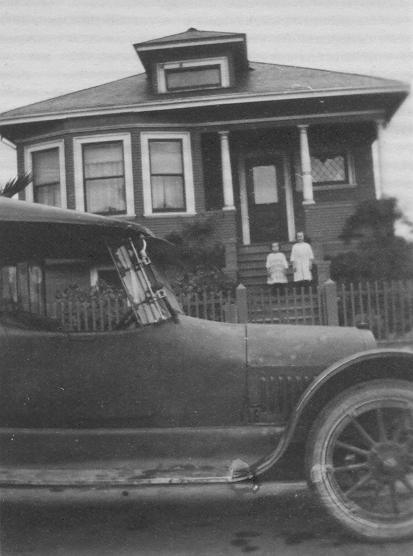
Thornally home at 1607 45th Avenue ca. 1913

Sometime before 1938 Sam moved his family to 3115 Kingsland Avenue in the Maxwell Park neighborhood near Mills College. This was a relatively new development that had begun construction in 1921. Sam was living in this home at the time of his death on March 4, 1938. He had a heart attack while driving the car with his family. His son Ed told me the story that he was in the back seat when it happened and Ed had to climb into the front seat to step on the brake and stop the car. Ed would have been 17 at the time.
Three of Sam's daughters plus a niece and granddaughter.
Marie, Lottie Pattillo, Vivian, Margaret, and Joey McKay
Sam married Delphine around 1929 and it is she that he is buried with at Mountain View Cemetery in Oakland. Their grave is near the caretakers shop very close to his brothers John and Will and their wives.
Family picnic - Standing L-R: Bert Pattillo, unknown woman, Ed & Lottie
Pattillo, Ricky Risoli (?), Dell Pesa, Sam, and Unknown man. Seated L-R:
John & Emma Thornally, Anna Pattillo, two unknown women.

Sam with Vivian and Lee


Samuel Thornally Part 2 – His Time As An Oakland Police Officer

Sam in his Oakland Police uniform

The following stories were found in newspaper archives. For some I have retold the entire story;
others are summaries of what was reported in the Oakland Tribune, San Francisco Call and the San Francisco Chronical newspapers.

KIND POLICEMAN MINUS PRISONER, December 19, 1911, San Francisco Call
Suspect Makes Dash After He Persuades Guard to Take Off Handcuffs
Persuading his custodian, Special Policeman Sam Thornally, to remove his handcuffs, William Wright, a pickpocket suspect, succeeded in making his escape this afternoon. Wright had been given permission to go to San Francisco under guard to obtain $2.50 bail for his release. Thornally, acting- as a Patrolman, was sent with Wright on the trip across the bay, and, having 'been warned that Wright would probably make an attempt to escape, kept his prisoner carefully guarded. Thornally and his prisoner entered the saloon of C. de Julio, 501 Broadway, where Wright said he could get the money. He persuaded Thornally to remove the handcuffs while he went into a room. Coming out. Wright dashed by Thornally and into the street. Thornally was foiled in giving chase and Wright had little difficulty in getting away.

FUGITIVE CAUGHT AFTER LONG CHASE William Wright, Who Escaped From Patrolman by Ruse, Again in Cell, January 7, 1912, Oakland Tribune
William Wright, alias Willie Holmes, the alleged pickpocket who escaped from Patrolman Thornally in San Francisco by a bold ruse December 17th, was recaptured across the bay yesterday, and has been returned to custody in the Oakland city prison. Policeman Thornally aided in trailing the fugitive and in his recapture.

Wright was allowed to go to San Francisco under guard to obtain bail from friends in that city, and Patrolman Thornally was sent to guard the prisoner. Wright was charged with vagrancy, the charge being sworn to as the police were unable to obtain sufficient evidence to hold him on a larceny charge.

Declaring that he did not wish to appear at the place of business of his friend manacled to the officer, Wright succeeded in persuading Policeman Thornally to remove the handcuffs. In the crowed entrance to a store he suddenly hurled the policeman out of his way and made his escape in the crowd.
Short notice from one of the local newspapers

 MISSING BOY MAY BE DEAD, September 13, 1912, Oakland Tribune
Sam and Captain Thornwall Brown searched in San Leandro, Hayward and San Lorenzo for 14 year old Dana Cronin. Mrs. Paul Bago suspected that her foster son had been buried in a sewer trench being constructed by the Spring Construction Company.

OWNER OF SCOW FOUND DEAD IN ESTUARY SLIME
Captain Thomas H. Stuart of San Rafael Apparently Murdered for Money
Wounds in Temple Made by Sharp Instrument About a Week Ago OAKLAND, September 22, 1912, San Francisco Call
The body of Captain Thomas M. Steuart of San Rafael, proprietor of the scow Redwood, was found today in the mud of the estuary, off the foot of Jones Avenue, under circumstances that point to murder. The police are attempting to ascertain whether three wounds over the right temple caused the man's death. Over the temple was found an abrasion and two small holes, made apparently by a sharp instrument. According to Dr. Mark X. Miner, made an examination of the body, the wounds were sufficient to cause death.

The body had been in the water almost a week, according to Deputy Coroner C. N. Cooper of the G. W. Murphy undertaking establishment, at 9032 East Fourteenth street, where the remains were taken. The body is badly decomposed, but was identified by J. W. Pickrell of 695 Jones Avenue, who knew Stuart for years. Pickrell last saw Captain Stuart about two weeks ago, when he helped to unload a cargo of sand that Stuart brought from San Rafael. According to John Cozad, a contractor living at 3 Bay View, San Rafael, for whom Stuart often took cargoes of sand, the last trip was made September 14. It is not known when he arrived here. Disorder in Scow Cabin About $11 was found in the pockets of the dead man, but his cabin on the scow was in disorder, leading to the theory that it had been rifled. Papers were scattered about and a hatchet was found that looked to Cooper as though it had been stained with blood. Captain Stuart was known to have money aboard the scow, sometimes several hundred dollars, and according to Pickrell, did not hesitate about exhibiting his money when in saloons. A search of the cabin failed to reveal traces of blood on the floor or walls, although such stains might have been obliterated. The hatchet is in the possession of the police, who will analyze the matter clinging to it to ascertain if it is human blood.
Historic photo of the Oakland estuary in 1919. Google image


Dead Man's Life Lonely
Captain Stuart lived a lonely life. When at this end of his trip he remained in the scow in the shallow
waters of the estuary. He mingled little with Alameda people and Pickrell thinks few other men assisted Stuart in unloading the scow here. His family life had been broken up through differences with his wife and he made his headquarters in San Rafael at a hotel. He lived formerly at 1815 Thirty fourth Avenue, but moved last spring. He has a wife and two sons, Edward and Charles, who live on a ranch at Santa Rosa, and his daughter, Miss Katherine Stuart, is an employee of Samuels' lace house, San Francisco.

Speaker Hangs Up Receiver When Asked to Tell Name to Coroner
Owing to Captain Stuart's mode of life much mystery surrounds the case. There is an unknown angle to the finding of the body, as a mysterious man who refused to reveal his identity, gave the first Information concerning it at a late hour last night.

Mysterious Phone Message
This man called Cooper on the telephone and said a body was floating in the estuary near the foot of Jones Avenue. When asked his name he hung up the receiver. The matter was postponed until daylight, when Cooper and Patrolman Thornally of the Melrose station found the body face down in the mud in almost the exact location given by the mysterious stranger. They waded out and dragged it ashore and then obtained a boat and made their way to the scow.
The scow this news story writes about probably looked
similar to this scow. Photo found on Google.

They made a minute search of the scow, finding the hatchet and many papers. Among the latter was a notebook containing the addresses of several women in Alameda, with their telephone numbers affixed in systematic order. Cooper says he called up these women and each denied any knowledge of the dead man.

Lodge Papers Found
Stuart was a member of San Rafael lodge No. 256, Benevolent and Protective Order of Eagles, and had a number of receipts signed by Secretary Charles Redding. The last was dated July 25.

He was insured in the Union Mutual Life Insurance company and had a receipt for dues to the company, signed by Cashier Helen Kuhl. The amount of j the policy and the beneficiary are not known. Besides these were a number of personal letters addressed to San Rafael and to his former local address, as well as several cards of business houses in San Rafael. He made regular trips with sand for John Cozard, and Cozard says that the last was made September 14. He was acquainted with John Kerrigan, a saloon man at 309 Fourth Street, San Rafael, and from him facts were obtained concerning Stuart's family.

Slight Heart Trouble
Stuart was between 50 and 55 years of age, but apparently in perfect in health, except for a slight trouble with his heart, which he spoke of some time I ago to Mrs. Pickrell while visiting her j home. At that time he laughingly said: "I presume this old heart of mine will stop suddenly some time and I'll die on the scow." The theory of natural death is not entertained by the police, for Doctor Miner said: "I found an abrasion and two deep wounds over the left temple, which in my opinion would have been sufficient, to cause Captain Stuart's death.'' These wounds, the police believe, could not have been self-inflicted, and there is no elevation on the scow from which he could have fallen. The case has been placed in the hands of the department of criminal investigation, and Inspector Thomas Wood is endeavoring to clear up the mystery. 
Watercolor painting of the Oakland estuary done in 1912 by
Christian Jorgensen. From Google

STEUART MURDER VICTIM? Police Believe Captain Was Slain Despite Adverse Decision of Coroner, Deckhouse in State of Disorder, Robbery May Have Been Motive, September 23, 1912, Oakland Tribune
Acting Inspector, Samuel Thornally testified before the jury that the dead man’s clothes were strewn about and his pockets turned out. The police also found a lot of blood on the scene but the Coroner ruled an accidental death based on the deceased daughter’s testimony that her father suffered from heart disease. The Coroner determined that Steuart suffered a heart attack, fell into San Leandro Bay and drowned.

DISAPPEARANCE IS PUZZLING POLICE No Trace Discovered of Missing Fruitvale Plant Expert, 25 September 1912, Oakland Tribune
The disappearance of Frank Finch, a plant expert and salesman who dropped from sight last Saturday under circumstances that led the authorities to believe that he may have met with foul play, is still puzzling the police. Acting Inspector Samuel Thornally has been detailed on the case by Captain of Police Thornald Brown and every effort will be made to get some trace of the missing man.

Mrs Finch at her home, 1755 Thirty-sixth Avenue, is on the verge of a nervous breakdown. The has two small children to care for. At the time her husband dropped from sight he had a large sum of money with him which he intended paying as a deposit on a real estate transaction to B. Magnesson, 1642 Ninety-sixth Avenue, Elmhurst. No trace can be found of the man after he left Magnessen, about an hour after leaving his home, saying he would be back in a short while to close up the deal for several lots in that neighborhood.

The theory is that Finch was robbed and murdered or drugged and is unable to communicate with his family. Finch arrived in Fruitvale three weeks ago from Oregon with the intention of settling here.

MAN SHOOTS WIFE AND THEN HIMSELF
Husband Objects to Woman Going to Brother's Home for Dinner
Special Dispatch to The Call OAKLAND, October 6, 1912
Mrs. Alice Silva insisted upon going to her brother's home for dinner today, even after her husband, Alfonso, displayed a revolver and informed her that unless she remained with him he would shoot her. Both are at the receiving hospital suffering from wounds that may prove fatal. After shooting his wife through the left lung, Silva sent a bullet into his own breast and another into his skull. The shooting occurred shortly after noon at their home, 9910 Walnut Street in Elmhurst.

Silva is a dairyman. 26 years old, and his wife is 25. Miss Marian Linds, who lives at the Silva home, was a witness to the shooting. When she attempted to dissuade Silva he said: "You get out or I'll kill you, too." Miss Linds remained quiet and saw Silva shoot his wife and then himself. Then she ran from the house screaming for aid. Patrolmen Nedderman, Sherry and Thornally rushed the couple to the receiving hospital, where Doctor Irwin and Steward-Piatt gave them medical attention.

According to Charles Silva, brother of the wounded man, the latter's wife repeatedly brandished razor at her husband and threatened to cut his throat. "For the last six months," said the injured man on the operating table, "the, wife has been cranky. She goes out frequently and visits her brother, Malcom Perry of 1800 Eighty-first Avenue. She doesn't want to stay with me. Today when she said she was going to her brother's home for dinner I told her that unless she remained at home and got dinner for me I would shoot her. She wouldn't listen to me, and I shot her and then myself." "My husband must have been Insane," said Mrs. Silva. Although their condition is serious. Doctor Irwin holds out hope for the "recovery of both.”

After Routing Husband, She Gives Officers Hard Battle Before Submitting to Arrest.
Oakland December 12, 1912
Mrs. Nellie Myers (weight 90 pounds, height five feet) gave battle to three husky policemen and her husband, Harry Meyers before she was subdued and placed under arrest. She will be held pending an examination as to her sanity.

The Meyers quarreled and Mrs. Meyers had no trouble in besting Meyers, who hurried to a telephone and called upon the Melrose police station for aid. Sergeant William Brackett and Patrolmen Thornally and Degelman went to the scene.

Mrs. Meyers refused to submit and another battle royal was begun, in which Mrs. Meyers finally was subdued. She denies that she is insane and says the trouble started because her husband had not kissed her for nine years. 
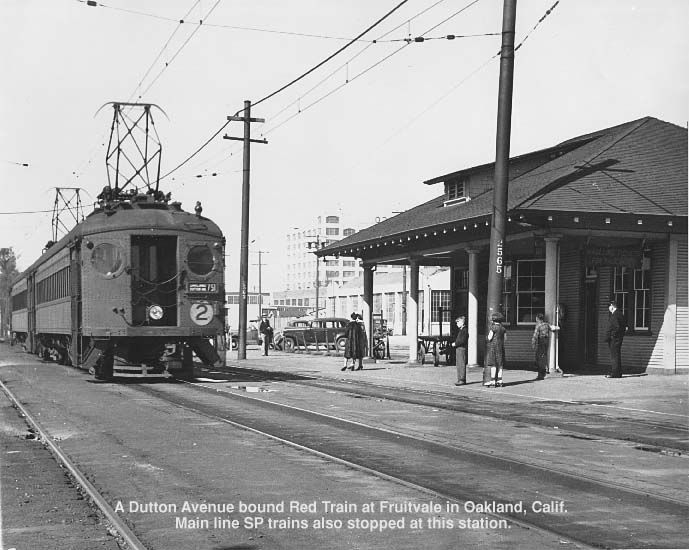
Southern Pacific Railroad Station at Fruitvale. Old
Montgomery Wards building in the background. From Google

TWO BOYS ROBBING SAFE
Police Detect Fads Fruitvale Railway Station OAKLAND, December 31, 1912
Patrolman Thornally and Special Officer Mason saw Fred Sheffield, I5 years old, and Maynard Cox, 17 years, at work at 2 o'clock this morning in the Fruitvale station of the Southern Pacific company, attempting to rob the safe. They had secured entrance by prying open a window with a jimmy. The youths were covered with revolvers and ordered to throw up their hands by Thornally and Mason. They started to run and Thornally fired a shot over their heads, stopping them. They were booked on charges of burglary.

PHONES BEFORE TRYING TO END LIFE; IS SAVED
Patrolman Finds A. H. Agard Lying in Bed With Gas Turned on and Drags Him Into Street
OAKLAND, May 9, 1913
A. H. Agard. 1315 Thirty-ninth Avenue, a searcher of records for many years, called up his brother, W. A. T. Agard of 2022 Woolsey Street. Berkeley, at 2 o'clock this morning to tell him goodbye before committing suicide. Agard, said that he had tired of life and had decided to end all. Agard's brother immediately notified the police, and Patrolman Thornally of the Melrose station hastened to the Agard home to find Agard lying in bed I with the gas turned on and the cracks and keyholes stuffed with rags. Thornally dragged Agard into the street and revived him. Agard's wife said, I recently left him because of family differences. She is now living with her parents at 1503 Fremont Street.
Sam's signature from his WWI registration form


Monday, February 19, 2018

Sally Phillips Pattillo My Third Great Grandmother on my Father's Side

Mecklenburg County Courthouse in Boydton built in 1842
during Sally's lifetime
Sally Phillips was the daughter of Pettus Phillips and Rebecca Coleman. She was born circa 1789 in Mecklenburg County, Virginia. On some records her middle initial is “E” and on others “C”. I prefer “C” guessing that it is for “Coleman” her mother’s maiden name. The Phillips family was from Mecklenburg County, Virginia. Pettus and his father Martin both lived in Mecklenburg County, as did Rebecca’s family. I know that Sally had at least one brother John Phillips and a sister Nancy because both were named in their father’s will.

In 1808, on December 15th Sally married Samuel H. Pattillo. He was 28 and she was 19. They were married in Mecklenburg County by Rev. James Meacham. Two and a half years later her sister Nancy married Marshall Mosely. Three years after that Sally gave birth to James Henry Pattillo, my second great grandfather. It seems unusual that her first child wasn’t born until six years after she was married which suggests that possibly other children were born earlier but did not survive.
Close up of young tobacco plants grown by Sally's family.

The births of three additional sons followed – Edward M. in 1816, Charles Madison in 1918, and Robert Alexander in about 1820.  Each of her sons lived to maturity, married and had successful careers. James was appointed Superintendent of the Poorhouse and Housing Stewart at Randolph-Macon College, Edward was a Justice of the Peace, and Charles was a Constable for Mecklenburg County.

When Sally’s father, Pettus Phillips died in 1821 she was 32. He left her a Negro man named Ben and $400 that was actually given to her husband Samuel W. Pattillo. A few years later in 1828 Sally gave birth to a daughter, Ann who married John W. Pearcy on February 13, 1873 and moved to Dinwiddie County, Virginia. That same year in December Sally’s mother Rebecca died.
Marriage Record for Ann R. Pattillo and John Pearcy.
Saml' Pattillo and Sally Phillips are listed as Wife's Parents

Sally’s husband Samuel died about 1840 when Sally was 51, so he was not there to witness the marriages of their children. Each of their children married between 1845 and 1873.

I have not found a record of when Sally died or where she is buried.

Sources: Melba Crosse book on the Pattillos; 1820, 1830 and 1840 censuses; Ancestry website; Marriages of Mecklenburg Co. book; will of Pettus Phillips; marriage document for Ann R.Pattillo.

Samuel H.W. Pattillo (1780 - ca. 1840) My Third Great Grandfather on my Father's Side

Samuel was the son of Solomon Pattillo and Sarah Major. He was the youngest of four children
Tobacco Gold growing in Mecklenburg Co. Virginia in 2017
Samuel Pattillo was most likely a tobacco farmer.
named in his mother’s will in 1817. He had an older sister, Rebecca who was born about 1774, and two older brothers Williamson, born about 1776 and Edward in about 1778. Samuel was born about 1780. All of these children were born in Dinwiddie County, Virginia.

It is not clear what his middle name was. In the Pattillo book by Melba Crosse she notes that she found two documents where he used “H” as his middle initial but in most records he used “W”. On the 1820 and 1840 censuses he is shown as Samuel W. Pattillo. On his marriage record it shows Samuel H. Pattillo. I’ve guessed that his middle name was Henry because his oldest son’s middle name is Henry. I’ve found no records that provide his middle name but someone on Ancestry noted his middle name as “Willis”.

By 1800 Samuel’s family had moved a little south to Mecklenburg County, Virginia where he appeared on a tax list in that year. Much of what I know about Samuel comes from court records I found when I visited the Mecklenburg County Courthouse in 2014 and 2017. The earliest of these documents is dated December 21, 1805 when Samuel is shown as a trustee in a debt agreement between Peter Peterson and a firm called Bilbo & Langley. This record is from Warren County, North Carolina. A Google search brings up two more references to Bilbo & Langley but neither explains what sort of firm it was.

Next is a deed from April 7, 1807 when he sold a 66-acre tract of land on Woodpecker Creek in Mecklenburg County to Willis Vaughn and his wife Edie.
Woodpecker Creek crosses Highway 49 and is southwest of Chase City
in Mecklenburg County, Virginia

On September 15, 1810 Samuel purchased a tract of land from Lewis Toone for 179 pounds. The purchase included “and appurtenances” which probably means a house and other farm structures. The curious thing about this transaction is that the debt was recorded in British pounds rather than American dollars – 34 years after the American Revolution.

October 18, 1811 is the first time Samuel appeared on a circuit court record when he was summoned to appear as a witness at the courthouse in Boydton, Virginia. That same year he purchased a 66-acre parcel of land from Willis and Edie Vaughn for $187. On the survey of this new piece of property one of the surveyor’s landmarks was labelled “Pattillo’s Corner Red Oak”, so it seems the new parcel was contiguous with a parcel he already owned. These two land transactions with the Vaughns are confusing – in one Samuel sold a 66-acre parcel to Vaughn and in the other he purchased a 66-acre parcel from Vaughn – maybe it was the same parcel that he sold and then bought back from the Vaughn’s.

Between 1813 and 1819 I found four more court documents involving Samuel. The first in November of 1813 was the circuit court case of Marshall Moody vs. Charles Burton. In March of 1814 Samuel served as the administrator of the estate of John Fair. This is interesting because it was typical at that time for the court to appoint a family member or other close associates to serve as the estate administrator. I have no idea who John Fair was or why Samuel was called upon to administer his estate. Fair could have been a neighbor or personal friend but there are no Fairs in our family tree as far as I know.

In March of 1819, when Samuel was 39, he was involved with a pair of interesting cases that came before the Grand Jury. One was an assault case filed against Thomas W. Gillespie who got into a brawl in a tavern. The other was against Alexander Gillespie who was accused of using profanity in the home of Henry Dedman. These seem like petty crimes – I wonder why they went to the Grand Jury?
Samuel would have taken his tobacco crob to a tobacco
wharehouse similar to this one in Chase City

Later in 1819 Samuel was called upon to appraise the value of the slaves owned by Thomas Spain who had passed away. At that time it was standard practice for a person’s estate to be inventoried and the value of his estate to be appraised. Local men in the community – typically land owners were routinely called upon to provide these services to the court. Samuel worked on the appraisal with William Brame, Charles Hutchison, William Baptist and John Jeffries.

Samuel’s mother Sarah died in 1817. Her will was dated April 4th of that year. In it she left Samuel one feather bed and furniture. Her son Williamson received, “one Negro man by the name Frank also one feather bed for him and his heirs ... I give and bequeath to my son Edward M. Pattillo one Negro boy by the name Littleton, 2 feather beds and furniture ….”. The remainder of her estate was to be equally divided among her four children – so her daughter Rebecca received substantially less than the sons.

On the 1820 Mecklenburg, Virginia census Samuel W. Pattillo was listed with his wife, children and six slaves. Samuel was 40 years old but the census provides no additional information.

Samuel was particularly active in civic affairs during the 1820s. I’ve found eleven court records from that decade. On May 21, 1821 Samuel served on another grand jury. The case had something to do with his father-in-law Pettus Phillips and the business Craddock & Pattillo. The court document notes that Samuel was paid $3.75 for his service on the jury but is unclear on other details. Craddock & Pattillo was a general store owned by David Craddock and Dr. William J. Pattillo – no relation. The store was located adjacent to the Quarter Horse Race Track in Christianville. Christianville is now called Chase City and is near the town of Boydton.
This is the courthouse in Boydton. Built 1838-1842 at the
end of Samuel's life.

Three of the court records were land transactions. On February 16, 1822 he and Sally executed two transactions – in one they sold a 70-acre tract of land to Alexander Clausel for $300, and in the other they sold a 100-acre parcel to Richard Harris for $600. The third land transaction occurred in March of 1824 when Sam purchased another 179 ¾ acres from Elizabeth Toone after her husband William Toone died.

The other seven cases involved myriad civic responsibilities. In June of 1821 he was again asked to appraise an estate – this time it was for a man named William Hurt. In August of 1823 he helped appraise the estate of John Murphy. He did another appraisal for the estate of Eliza Farrer in 1826. At the end of the decade on December 21, 1829 Samuel was a surety (a person who takes responsibility for another's performance of an undertaking) in a case involving Elizabeth Baskerville – “a person of unsound mind”. Makes you wonder what that was all about.

On the census of 1830 Samuel was living in a household with 8 others – there were 7 males including Samuel and two females – his wife Sarah and their youngest child, a daughter Ann who was born in 1828. Only Samuel was identified by name. Neither slaves nor free persons of color were recorded on the census that year.

I have found only two court documents for Samuel from the 1830s. One indicates that he served on another jury when he was 50 years old. I don’t know what the case was about. Then in 1831 he was a surety for the estate of Martha Butler. A newspaper article in the Richmond Enquirer dated September 2, 1836 includes the name Samuel W. Pattillo as a member of the Republican Van Buren Committee who endorsed “Martin Van Buren of New York and William Smith, of Alabama for President and Vice President of the United States.” 
Downtown Boydton in 2017 - a designated historic district

On September 23, 1841 Samuel did something that seems peculiar. He signed an agreement to pay several debts he owed to five individuals not later than April 1, 1843.  And, he put up practically everything he owned as collateral – including the 200 acre tract of land he lived on, plus his entire household and kitchen furnishings, his plantation tools and utilities, all his feed and animals, his shotgun and all the crops that were currently growing on his plantation plus the crops from the upcoming year. The total of what was owed came to $875.40. The equivalent in 2017 is $23,633, so the debt was not huge – so why did Samuel have to risk everything he owned?

I don’t have a date of death for Samuel. Crosse believes he died sometime before the 1840 census because he was not enumerated on that census. He would have been about 60 years old when he died. In May of 1841, his son Charles was appointed to administer Samuel’s estate. The inventory included 1 parcel of corn, 1-2000 pound slack (presumably an old spelling of sack) of oats, 2-1200 pound slacks of oats, 2 slacks of fodder (350 and 500 pound), 1 parcel of fodder, 1 parcel shucks, 1 600 pound parcel of tobacco, 1 Bay mare, 1 dark Bay heifer, and 1 yearling. The total value came to at $92.31 ($2917 in 2017). This doesn’t seem like much for someone who was a landowner. Given Samuel’s extensive civic involvement it appears he was a man of some stature in the community – trusted and well-regarded.
1840 Mecklenburg County census. Samuel is listed 4th from the bottom.

None of the documents I’ve found for Samuel say that he was a farmer but given the contents of his estate and knowing that the vast majority of men living at that time in Virginia were farmers, I think it is safe to assume that that was his profession and way of life. I know that his son James Henry, my 2nd great grandfather was a tobacco farmer so it is likely that Samuel grew the same crop for income.

For information about Samuel’s marriage and children read the post about his wife Sally C. Phillips.

Sources: Melba Crosse book on the Pattillos; 1820, 1830 and 1840 censuses; Ancestry website; tax and other court documents including land deeds; Marriages of Mecklenburg Co. book; the will of Samuel’s mother; and Samuel’s probate documents.

Detail of an abandoned farm storage structure.
2017 Mecklenburg County