Friday, June 8, 2018

John "Swearing Jack" Waller (1741-1802) Part 4

Robert Baylor Semple, who wrote this biography of
John Waller for his book "History of the Rise and
Progress of the Baptists in Virginia" in 1810

JOHN WALLER[1]
No character has as yet passed before us, more worthy of notice than the present.
He was born, December 23, 1741, in Spotsylvania county; was a descendant of the honorable family of Wallers in England. At a very early period, he manifested a great talent for satyrical wit. This determined his uncle, who had the direction of his education, to bring him up for the law. He was put to a grammar school; and made an encouraging advancement in the dead languages. His uncle’s death and his father’s narrow resources, added to his own unbridled inclination to vice, prevented him from finishing even his classical education. He now began indeed to study, not the laws of the land, but those of the gaming table. Letting himself loose to every species of wickedness and profanity, he quickly acquired for himself the infamous appellation of, Swearing Jack Waller; by which he was distinguished from others of the same name. So far did he indulge his mischievous temper that he once had three warrants served on him at the same time, on account of one uproar. It was frequently remarked by the common people, “that there could be no deviltry among the people, unless Swearing Jack was at the head of it.” He was sometimes called, the Devil’s adjutant to muster his troops. To these, may be added, his fury against the Baptists. He was one of the grandjury who presented L. Craig for preaching. This happily terminated in his good. Craig, in order to turn their mischievous intentions into something beneficial, watched the demission of the grandjury; and in order to gain their attention, more certainly, bought them a mug of grog. After he had gotten them together, he began, “I thank you, gentlemen of the grandjury, for the honour you have done me. While I was wicked and injurious, you took no notice of me; but since I have altered my course of life, and endeavoured to reform my neighbours, you concern yourselves much about me. I have gotten this mug[2] of grog, to treat you with; and shall take the spoiling of my goods joyfully.” When Mr. W. heard him speak in that manner, and observed the meekness of his spirit, he was convinced that Craig was possessed of something that he had never seen in man before. He thought within himself, that he should be happy if he could be of the same religion with Mr. Craig. From this time, he began to attend their meetings. And was found of the Holy Spirit. The commandment came and he died. He saw and felt himself a sinner. He now, for the first time, except in blaspheming, began to call upon the name of the Lord. His convictions were deep and pungent. He ate no pleasant bread and drank no pleasant water, for seven or eight months. He was almost in despair. He relates his exercises in the following words:

“I had long felt the greatest abhorrence of myself; and began almost to despair of the mercy of God. However, I determined in my own soul, never to rest from seeing, until it pleased God to show mercy or cut me off. Under these impressions, I was at a certain place, fitting under preaching. On a sudden, a man exclaimed, that he found grace; and began to praise God. No mortal can describe the horror with which I was seized at that instant. I began to conclude my damnation was certain. Leaving the meeting I hastened into a neighbouring wood, and dropped on my knees before God, to beg for mercy. In an instant, I felt my heart melt, and a sweet application of the Redeemer’s love to my poor soul. The calm was great; but short.”
Drawing of a Circuit Rider, which John was, by Frank Beard
from the General Commission on Archives and History
From this time, he felt some increase of strength; yet at some times, he felt the enemy break in upon him like a flood; and he would be almost ready to give up his hope. But the application of these words gave him great comfort; “Who is among you that feareth the Lord; that walkth in darkness and hath no light; let him trust in the name of the Lord, and stay upon his God.” Isaiah50.10. And again: “By this we know that we have passed from death unto life, because we love the breather,”

By the time Messr. Harris and Read came on their next tour, he felt sufficiently confident to become a candidate for baptism; and going up into Orange county, was there baptized by Mr. Read, some time in the year 1767.  Baptism was to him, as it was been to thousands, a sanctified ordinance. His soul received great accession of strength and comfort. Christ was revealed in him.  Having contracted debts by dissipation, he sold property to pay them. He conferred not with flesh and blood, but began to preach, that men ought every where to repent. It was not long before his labours became effectual, at least, in one way. That arch enemy of souls, whom he had served so faithfully before, now began to roar in hideous peals against him. He succeeded in raising up a powerful opposition.

At length, it was thought proper to constitute a church, in Mr. Waller’s neighbourhood; who making choice of him as pastor, he was ordained to the work of the ministry, June 20th 1770. He now began to lengthen his cords. Bending his course downwards, he baptized Rev. William Webber, being the first he did baptize. October, 1770, accompanied by J. Burrus, he travelled down as far as Middlesex. Where ever he went, he was attended by a divine power; turning many to righteousness. His name sounded far and wide. By the ungodly, he was considered as a bold, inexorable fanatic, that would do much mischief unless restrained. The Baptists and their adherents looked upon him as set for the defense of their cause; and with much confidence rallied around him as their leader. His persecutions and imprisonment in Caroline, in Middlesex, in Essex, etc. have been already mentioned in our General History.

In this bright and burning way, Waller continued until 1775 or 1776, when he formed an acquaintance with one Williams, a preacher of some talents, apparent piety, and in Mr. Wesley’s connexion, consequently an Arminian; this man, by his conversation and books, so wrought upon Mr. Waller’s mind, as to bring him over to believe the Arminian system. Knowing this to be contrary to the opinions of his brethren, he resolved to make a bold effort to preach and argue his principles at the next association; and thereby convince his brethren; or failing in this to submit to be cut off from them. Accordingly, he took his text I Cor. 13. 11. In his exordium, he stated, that when young and inexperienced in religion, he had fallen in with the Calvinistic plan; but that becoming more expert in doctrine, or in the language of his text, when he became a man, he put away these childish notions. He then went lengthily into the arguments. For want of truth, or for want of talents, he made few, if any converts to his opinions; and of course, had to confront the whole host of preachers and members now assembled. Mr. Waller, foreseeing his fate, took the shorter and more reputable course. Instead of awaiting a fair trial, he proclaimed himself an independent Baptist preacher. This step was probably resorted to by Waller, under an expectation that his popularity was so great, that he should be able to bring over many of the churches to his party. Be it as it may, he immediately commenced his operations on an extensive plan. On his return from the association, he used his utmost endeavor to form a strong party. He preached from house to house; spread his wings over a large field of ministerial labour; ordained lay elders in every neighbourhood, to prevent inroads; and also several helps in the ministry. He also established what he called camp meetings; in which, they continued together several days, under certain written regulations, of which the following is an extract.

Camp Meeting Regulations
I.                    No female, on any account whatever, shall be permitted to stay in the camp, later than an hour by sun at night; nor appear in the camp, earlier than an hour by sun in the morning.
II.                  The persons in the camp, shall depend for sustenance, during the camp meeting, on the friendly hospitality of the neighbourhood.
III.               Any person in camp, waking at any period of the night may pray or sing, without disturbing the slumbers of others.

The novelty of these meetings, excited the attention of the people in such a manner, that great multitudes crowded after him.

By these means, his party gained strength daily. Few men possessed greater talents for heading a party of this description, than Mr. Waller. The only thing in which he was deficient, was, that he could not be happy while separated from his brethren. He used to say, that in the midst of apparent prosperity and the caresses of his friends, he still yearned after the people of God from whom he had withdrawn. Some years after his restoration, he said to a young preacher who was dissatisfied, and talked of dissenting, “If you could have a distant view of my suffering and leanness of soul, while a dissenter from my brethren, you would never again indulge such a thought”. He was again fully reinstated in connection with his brethren, in 1787; when a full union between Separates, Regulars and Independents was accomplished.[3]

A very great revival commenced under Mr. Waller’s ministry, in 1787. This continued for several years; and spread through all his places of preaching. In this revival he was greatly engaged; and baptized from first to last, many hundred. Early in this revival, Mr. A. Waller, son of his brother Benjamin, was brought in; and in some few years began to preach. Mr. Waller immediately recognized him as his successor; and declared that he believed his work in that part of the earth was finished. Accordingly, November 8th 1793 after taking the most affectionate farewell of the churches, he moved his family to Abbeville, in the state of South Carolina. This removal was said to have arisen, partly from economical considerations, and partly from a strong desire on his own, and on the part of his wife, to live near a beloved daughter; who had some time previously, married Rev. Abraham Marshall, of Georgia. Perhaps there might be other causes. His labours in his new residence, were also blessed; but not to a great extent. He remained, however, faithful in the cause, until his death; which took place, July the 4th, 1802.

His death was, as might be hoped and expected truly glorious. His eldest son describes it, in the following words:

“His conflict with death, as it respected bodily affliction, was truly hard; but his soul appeared to be happy indeed! Never did I witness such a resignation and Christian fortitude before! He was reduced to a perfect skeleton; and, in several places, the skin was rubbed off his bones. His pains appeared to be excruciating; but no murmur was heard from his lips. On the contrary, he would often say, “I have a good Master; who does not give me one stroke too hard, or one too many.”

“The last sermon he preached, was on the death of a young man. The text on which he preached, was Zachariah 2.4. `Run speak to this young man.’ He addressed himself chiefly to youth; in feeble, but animating strains: observing that he counted upon its being the last sermon he should ever preach; and fervently prayed, that, Sampson like, he might slay more at his death than he had done in his life. He continued speaking until his strength failed him. And with reeling steps, he advanced to a bed; where we thought he would have expired. From thence he was removed home in a carriage, for the last time. He said, as to his soul, he was under no concern; as he had given it to Jesus long since: and he was under no doubt but what his Master would provide a mansion for it. Just before his departure, he summoned all his family around him, black and white; and told them, he was anxious to be gone and to be present with Christ: and then warned them to walk in the fear of God; cordially shook hands with all; and soon after, with a pleasant countenance, breathed his last and fell asleep in Jesus. I looked on the corpse, with these words fresh in my mind:
“O lovely appearance of death.”
Thus this great man of God, conquered the last enemy and ascended to that rest, that remaineth for the people of God. He died in the sixty second year of his age; having been a minister of God’s word for about thirty five years; having in that time, lain in four different jails, for the space of one hundred and thirteen days, in all; besides buffetings, stripes, reproaches, etc. Nor was his labour in vain in the Lord. While in Virginia, he baptized more than two thousand persons; assisted in the ordination of twenty seven ministers; and helped to constitute eighteen churches. For many years, he had the ministerial care of five churches; to whom he preached statedly.

As a preacher, his talents in the pulpit, were not above mediocrity; but he was certainly a man of very strong mind. His talents for art and intrigue, were equaled by few. This he exercised sometimes, as it was thought, beyond the innocence of the dove. He was perhaps too emulous to carry his favourite points; especially in associations. Yet it must be owned, that such influence as he acquired in this way he always endeavoured to turn to the glory of God.

He had been married to Miss E. Curtis, previous to his becoming religious. By her he had a number of children; some of whom the old man had the happiness to see profess the same faith with himself.


[1] I transcribed this text with the original spellings and punctuation but changed the style of the letter “s” which in the 1810 text looked like an “f”.
[2] Mr. Craig was remarkably pious and zealous; availing himself of every opportunity to inculcate the gospel of Christ. He knew the grog was the most certain way to command the attention of the grandjury, to whom he desired to offer a lecture. “Be ye wise as serpents and harmless as doves.”
[3] A partial restoration had taken place some years before this so that Mr. Waller and his party met in association with the Separate Baptists.

Wednesday, May 30, 2018

Benjamin Waller (1768-1804) My 4th Great Grandfather on My Father’s Side

John Spotwood - the man the county is
named after
Benjamin Waller was the fourth of nine children born to John Waller and Elizabeth Curtis Waller. He had two older sisters Elizabeth and Ann “Nancy” and one older brother John Nicodemus Waller. He also had four younger sisters and one younger brother. The sisters were Frances, Mary, Phoebe and Dorothy Virginia. His younger brother was Thomas Baxter Waller.

Benjamin was born in Spotsylvania, Virginia as were all of his siblings. Spotsylvania was named for Governor John Spotswood who led an expedition of pioneers and gentlemen across the Blue Ridge Mountains to Virginia. He was named as the first Lieutenant Governor of Virginia in 1710.The county of Spotsylvania was formed on May 1, 1721and was also known as St. George’s Parish. When the county was formed “500 pounds was budgeted for a church, a courthouse, a prison, a pillory and stocks, which, in the legislation of the times, were always associated as the necessary requisites of a good government.”  History of St. George’s Parish by Rev. Phillip Slaughter.

The exact date of Benjamin’s birth is unknown. I know little about his childhood except that he was raised in the household of a rather notorious Baptist minister and that the family moved from Virginia to South Carolina. The family must have been relatively wealthy because in 1801 they owned 19 slaves.

Sometime before 1789 Benjamin married Joanna Thompson – a native of South Carolina. See my blog post dated August 29, 2017. In October of 1793, Benjamin and Joanna purchased 369 acres from Benjamin’s parents for 75 pounds. This was before the American Revolution so Virginia was still controlled by the British crown – hence pounds instead of dollars. About one month later, Benjamin sold 140 acres to Edmund Clark. I don’t know if it was from the tract he purchased from his parents or a different parcel.
This Wikipedia map of Virginia shows the location of
Spotsylvania county in red
Benjamin and Joanna had moved to South Carolina by November of 1796. I know this because Benjamin was one of the men who prepared an inventory of the estate of Hasting Dial on November 16th of that year. Benjamin was listed on the 1800 Abbeville census in Abbeville County, South Carolina. The census noted that there were two males, four females and thirteen slaves in the household at that time. Having that many slaves suggests that Benjamin and Joanna owned substantial acreage.

When Benjamin’s father Reverend John Waller died in 1801, he stipulated in his will what his wife and each of his nine children should receive. Benjamin was given a bay colt and four slaves named Jeffry, Aleck, Sukey and her child Gabriel. The will also said that when John’s wife died the remainder of his estate was to be sold and divided equally among his children.

Benjamin died three years after his father died. He was 36. I found a copy of his will and other probate documents when I visited Abbeville in 2017. Those documents reveal quite a bit more about his life. At the time of Benjamin’s death he owned 15 slaves. He left Rachel and her child Willie, Fielding, Armestead, Cloe and Garrett to his wife Joanna, as well as a good feather bed and furniture, a cupboard and cupboard furniture - nice that he left his wife a “good” bed as opposed to a ratty old one.
This is a small piece of Benjamin's will that says what he
leaves to his daughter Hulda and his unborn child
Each of his children received one or more slaves. His eldest Betsy got Shannon, Matilda received Jacob, John got Clara and her son Jack, Sukey and her child Precilla went to Guilford, and my 3rd great grandmother Hulda received Davy. Joanna was pregnant with their last child as Benjamin had his will and last testament prepared so he left Merian and Agga to the then unborn child. Joanna chose to name the baby after her deceased husband – he was Benjamin F. Waller, born sometime in 1804.

Two of Benjamin’s brothers William and Thomas B. Waller along with George White inventoried Benjamin’s estate on May 3, 1804, and arranged for his debts to be paid. Within the estate documents are a few records of mild interest, for example, in 1813 payments were made to purchase a bonnet and bridle for Benjamin’s daughter Matilda and a bridle and saddle for Hulda. School tuition was paid for sons Guilford and “Henry” – was this a nickname for John Harvey? Other expenses associated with maintaining the slaves they employed included $8.50 for a doctor to tend to Davy, $6 for Dr. Meriweather to attend to Sukey, and $4 for a blanket for Clay.
A view of downtown Abbeville in 2017
Between 1807 and 1813 payments were made to the estate when Charles McGehee hired Clay, Robert Finey hired Davy and Moses Drummond hired Sukey to work for them. All this generated a total of $141.15 in income to the estate. The inventory of everything Benjamin and Joanna owned at the time of his death is seven pages in length. The appraised value came to $5310.59 and included the following:

Household & Personal Items
Knives and forks, Spinning wheel, 1 Loom, Tray sifter, Small glass, Candle stick, a lot of buttons, Walnut Desk $24, Family bible $8, Geography book, Dictionary, Blank Book, The Christian Religion, Small Bible, Picture Book, Small Book, Pamphlets, Watch, 6 Windsor Chairs, Table, Small table, 8 Common chairs, 1Arm chair, 2 salt cellars, 4 beds & furniture, Trunk of shoes, Case & bottles,1 Trunk, 1 old chest, Shot bag, Small and large pot, Trays, a lot of pewter, 2 butter ?, Powdering table, 2 churns , Coffee mill, Jug, Iron tea kettle, 2 shot guns

Farm Equipment
½ gallon measure, Pair of saddle bags, Pewter pot, 5 stakes of blades, Pair of fire dogs, Nails, Powder 400#, Scales, Money scale, Saddle ,Keg white lead, Old chest, Barrels, ? for corn, Pair of ? irons, 1 knife and bonnet, 2 scythes & cradles, Old irons, Hoes, Mattock, Augers, Axes, Ax & Wedges-several sets sold to individuals, Share mold, Iron ware, Stellyards, Lock chains, Saddle, Iron bound keg, Cut saw, Swingle free, Shovel plow, Plough, Chain tracer, Grind stone, 2 funnels, Cart, and a kettle

Food & Feed Items
1 bee hive, Bee gum, Small flour barrel, 3 small kegs, 240 bushels of corn, 110 gallons of brandy

Animals
2 small Bay horses, 2 sorrel horses, 1 Bay colt, 1 sorrel colt, Black horse, Roan colored horse, 18 geese, 7 bison, Hogs – 7 people purchased, Sow, Steer, Bull, Cow with bell, Small cow, Dun colored cow, Black cow & calf, 3 Brindle cow & calf, 19 more cows and calves

Slaves
Jeffery, Alexander, and Violet

Land
202 acre tract Joanna bought and 326 acre tract that George ? bought

Misc
360 units of Cotton

Note: a ? indicates words I could not read on the original documents.

This is one page of the appraisal of Benjamin's
estate prepared by Natham Lipscomb
Sources for this post include: Benjamin Waller's probate documents, 1800 census, Find-A-Grave and Rootswebsites, "Abbeville Marriage Records" by Larry Pursley, "Greenwood County Sketches" by Margaret Watson, Spotsylvania County Records 1721-1800, Will Abstracts for Abbeville by Willie Pauline Young, the will of Rev. John Waller,

Hulda Waller 1797 – 1829 My Third Great Grandmother on My Father’s Side

This map of South Carolina clearly shows the Ninety Six
District in the northwest portion of the state
Hulda was the daughter of Benjamin Waller (1768-1804) and Joanna Thompson (1772-1834). She was born in 1797 in a geographically large county located in the northwest part of South Carolina known as Old Ninety Six District. “Ninety Six has a colorful history dating back to early colonial times when a settlement began at the 96th milepost from Keowee Indian village, on a trail used by traders with the Native Americans. A small store, run by Robert Goudy supplied traders with such items as rum, sugar, and gunpowder, is on record as existing as early as 1730. Most likely, Ninety Six received its name when Indian maiden Issaqueena (Cateechee), rode her horse, ninety six miles from Keowee, the capital of the Cherokee nation to the outpost to warn of impending war by the Indian natives.” In 1785, Abbeville County was
formed from Old Ninety Six. Abbeville and the surrounding areas were mostly cotton plantations during her lifetime.
I found this interpretive panel on the Spotsylvania Museum website. It
depicts how the county got its unusual name.
Hulda had two older sisters Elizabeth and Matilda and three younger brothers John Harvey, Gilford and Benjamin F. Waller. When Hulda was seven her father Benjamin died at the age of 36. Shortly thereafter her mother married Stephen Watson, sometime between 1804 and 1807. Stephen was a widower who had a daughter Margaret “Peggy” Watson who was seven years younger than Hulda. Stephen was the son of Edward and Margaret Watson. He was born in Abbeville, South Carolina, and sadly died there in late 1806 or early 1807 just a short time after marrying Joanna. In his will, Stephen named his brother William Watson and his friend John McGehee as the executors of his estate.

After Stephen died Hulda’s mother married for a third time to Captain Charles McGehee, who was probably a brother of John McGehee but that is not known for certain. In October of 1809 Charles was made guardian of Peggy Watson. He was born in Caroline County, Virginia and was a wealthy land and slave owner in Abbeville at the time he married Hulda’s mother.
Hulda’s stepfather Charles also died young - he was only 47 when he died in January of 1816. Hulda would have been nineteen at the time. So, in a period of twelve years Hulda experienced the death of her father and two stepfathers. Makes one wonder how she was impacted by the many changes and disruptions in the household and by the deaths and marriages.  Hiram Gaines was a witness to Charles’s last will.
This is Cross Keys Plantation which was located in
Old Ninety Six District and is the type of residence that Hulda
would have been familiar with. Found on Google.

In 1916, Hulda’s sister Matilda married Martin Hackett Jr., and two years later Hulda married Hiram Gaines, in about 1818. Hiram was a music teacher living in Abbeville, and apparently a friend or at least an acquaintance of the family since he witnessed Charles’s will. The exact date of their marriage is unknown because Abbeville had two major fires that destroyed most of the town’s records. Much of what is known about Abbeville, during Hulda’s lifetime, was extracted from newspapers by local historians.
In 1826, Hulda’s daughter Joanna was born – my 2nd great grandmother. See my blog post dated August 5, 2017. Joanna was no doubt named after her grandmother, Joanna Thompson. About one year later Joanna’s sister Margaret A. Gaines was born about 1827. I have not been able to find anything more about Margaret. Was she named after Hulda’s half sister Margaret Watson? 
John Calhoun was Abbeville's most famous
resident during Hulda's lifetime. He served
as US Vice President with John Quincy Adams
Hulda died in Abbeville in 1829 at the age of 32. Her husband Hiram died a few months later on December 31, 1829. South Carolina’s most famous son, John C. Calhoun was born fifteen years before Hulda and during her lifetime he served as Vice President under John Quincy Adams (1825-29), also as Secretary of War and as a US Congressman. Calhoun’s prominence would have reflected on Abbeville and given the town stature, so it would have been an interesting time to be living there.

Sources for this post include: The will of Joanna Thompson, "Greenwood County Sketches" by Margaret Watson, "Abbeville Marriage Records" by Larry Pursley, and good `ol Google search.

Friday, April 27, 2018

Sam Thornally (1885-1938) My Granduncle on My Mother’s Side


Sam from a 1926 news article

Samuel Thornally was the youngest son of William Gilliat Thornally and Mary McGowan. He had three older brothers – Will Jr., Harry Melville, and John Roger, my grandfather. He also had an older sister Charlotte who died when Sam was thirteen and a younger sister, Rose Mary who outlived all her sibling by many years. You can find posts about each of Sam’s siblings on this blog.

Sam was born on October 18, 1885, in Fruit Vale – now part of the city of Oakland. Since his Irish mother was raised as a Catholic Sam was baptized on July 31, 1886, at St. Anthony’s Church on 16th Avenue in the Fruit Vale neighborhood. According to Sam’s grandson, Randy Thornally, “Mary was not a practicing Catholic here in California per an arrangement with her husband, William Sr. …. William’s mother Mary Gilliat is probably descended from French Huguenots…. The Huguenots in France were never happy with the Catholics. The English were not particularly happy with the Catholics either, and finally split the English Catholic Church apart.” Randy continues, “My father Edwin Thornally thought his father Samuel was probably “sneaked” out of the house and baptized as “insurance.”

When Sam was fourteen he appeared on the 1900 census. At that time his family was living at 288 Bray Avenue in Fruit Vale which was considered part of the Brooklyn Township. Sam and his sister “Rosie” were attending school and all three of his older brothers aged 17, 21 and 24 were working. John as a painter and Will and Harry were carpenters, as was their father William Sr.

When Sam was seventeen his brother Harry married Blanche Wimble on June 16, 1903. Four months later his brother Will married Agnus Damm on October 29, 1903. In the 1904 City of Oakland directory, Sam was listed as a Seaman in the United States Navy. He was nineteen years old. While in the Navy Sam spent time in the Philippines and other countries in the Far East. Randy has vague recollections of having seen souvenirs that Sam brought home after his time in the Navy – some of which were destroyed during the 1991 Oakland firestorm. Sam was not listed in the 1905 directory which suggests he was still serving in the navy at that time, but he did appear again in 1906. Sam’s profession was listed as a carpenter in the 1907, 1908, 1910 and 1911 city directories. It is possible he was working with his brother Will who had established his business as a building contractor in 1905.
Sam standing at the left with a few of his Navy
 friends, circa 1904

When the census was taken in April of 1910 the family had moved to 1707 Fruitvale Avenue. Only Sam 23 and Rose 21 were still living at home. Sam was working as a carpenter and Rose was a stenographer for the Southern Pacific Railroad.

On June 29, 1911, Sam was appointed as a substitute patrolman in the Oakland police department. He was 25 at the time. On January 6, 1913, an article in the San Francisco Chronical reported that Sam was working as a motorcycle cop and he and his fellow officers had nabbed 27 speeders. Sam continued to serve on the Oakland police force until he was injured and had to leave the force in 1922. The injury was a burn to his eye with iodine that impaired his vision so much that they determined he could no longer do his job properly. During his time as an officer reports of Sam’s pursuits and arrests were written about and published in the Oakland Tribune, San Francisco Call and San Francisco Chronical newspapers. The post that follows this one recounts some of the cases that Officer Thornally was engaged in during his time with the Oakland Police Department.

Like his older brothers, Sam was involved in a variety of civic affairs. The earliest newspaper article I found that mentioned Sam was a story about his having attended a memorial service for members of the Native Sons of the Golden West. This was on November 7, 1910. The event took place at the Unitarian Church in downtown Oakland. On Feb. 17, 1911, Sam was again mentioned in a San Francisco Call article when the Fruitvale chapter of the Native Sons challenged the Piedmont chapter in some sort of competition.
Sam and Arjetta

Sam’s mother Mary Thornally died in January of 1912 when he was 26.  Later that same year Sam married Marie Arjetta Land on September 5th. They were married at St. Elizabeth’s church in their Fruitvale neighborhood. Arjetta (1889-1934) was the daughter of Jennie Lee Land (1871-1946) and an unknown biological father. She was the granddaughter of Thomas Rease Land (1828-1891) and Jane "Jennie" Diana Carlton (1841-1877). 

Sam and Arjetta had six children. The first Samuel McGowan Thornally Jr. only survived three months but the other five lived full lives. They were Marie Arjetta (1915-1994) nicknamed Jerry, Margaret Cecilia (1918-1983), Edwin Joseph “Ed” (1921-2001), Vivian “Dee” (1923-2004), and Leland Francis “Lee” (1926-2008). All were born in Oakland, California.
Arjetta with Samuel Thornally Jr.

In 1913, the family was living at 1607 45th Avenue. They were still at that address when Sam registered for the draft for World War I on September 12, 1918. Sam was 33 years old and described as having a medium build, medium height with blue eyes and light brown hair.

Like his brothers and sister Rose Sam owned one of the single-family homes that his brother Will Jr. built for each of the family members within the Thornally Tract. That was located on Redwood now 35th Avenue on both sides of Bray Street aka Elm or East 17th Street. I have not found any record proving that Sam ever lived in the home.
Sam's home in the Thornally tract

When the 1920 census was taken the family had moved back to 51st Avenue but were now living in a home they owned at 1426. On the census, the household included Sam, his wife Marie, two daughters, Marie and Margaret and Sam’s mother-in-law Jennie Lee Land. Sam was identified as an Oakland policeman on that census.

Around 1923, after Sam was put on permanent disability from the Oakland Police Department he bought a bar and confectionary shop located in downtown Niles. My mother Lottie Pattillo recalled driving to Niles with her parents and having to wait in the car with her mother while her father John visited with Sam inside the bar. She enjoyed the drive but not the waiting. Sam and his business partner Cort Goeesel bought “The Classic” restaurant from Mrs. Etta M. Young in 1926. The news clip with this story says that Sam had been living in Niles, had moved back to Oakland but planned to return to Niles to run the restaurant. The article noted that the restaurant was being remodeled and would open the following week at the end of June. 1926 was ten years after Charlie Chaplin stopped making silent films in Niles.
Thornally home on 51st Avenue

Sam continued to operate the shop during prohibition that was in force from 1920-1933. Apparently, the bar was upstairs so out of sight. Sam had a friend Delphine Pesa who worked for the phone company. She could listen in to the police calls and would call and warn Sam whenever a police raid was about to take place. That is how he avoided being arrested for selling alcohol illegally. Around this time Sam and Marie were separated and Sam started dating Delphine but when Marie became pregnant with their youngest child Lee, Sam moved back in with Marie. Unfortunately, the marriage did not work out and ultimately they divorced.

An article published in the Oakland Tribune on May 5, 1926, reported, “Split on Religion. Sam Thornally told his wife she was a detriment to him because of her religion and declared he would break her will in that regard if it took 100 years, Mrs. Marie A. Thornally, 1426 51st Avenue alleges in a suit for divorce.”
Arjetta, Sam and Marie

Sam was still listed in the Oakland directory in 1924 but in 1926 he moved to Niles and lived there until about 1929 when he returned to Fruitvale. A news headline tells us, “Sam’s back in town again and has joined the sales staff of the F.H. Dailey Motor Co., Eastlake Ford dealers. For several years past he has been in business at Niles but is back again in his old stomping ground, Fruitvale where he was born and spent his childhood days.” The story went on, “Sam has always been prominent in Fruitvale parlor Native Sons and was the first member elected to the office of marshal in that order. During one of those memorable Admission Day Celebrations in San Francisco, Sam led the boys’ band of St. Elizabeth’s church in the parade. The tallest boy in the band measured 31 inches and the trombone player was so small Sam had to carry him on his shoulders. And Sam and the band won first prize in the parade. Them were the happy days.” The F.H. Dailey Motor Company was founded in 1910 in Oakland and later opened a branch in San Leandro. F.H. Dailey still exists in 2018.
Thornally home at 1607 45th Avenue ca. 1913

Sometime before 1938 Sam moved his family to 3115 Kingsland Avenue in the Maxwell Park neighborhood near Mills College. This was a relatively new development that had begun construction in 1921. Sam was living in this home at the time of his death on March 4, 1938. He had a heart attack while driving the car with his family. His son Ed told me the story that he was in the back seat when it happened and Ed had to climb into the front seat to step on the brake and stop the car. Ed would have been 17 at the time.
Three of Sam's daughters plus a niece and granddaughter.
Marie, Lottie Pattillo, Vivian, Margaret, and Joey McKay
Sam married Delphine around 1929 and it is she that he is buried with at Mountain View Cemetery in Oakland. Their grave is near the caretakers shop very close to his brothers John and Will and their wives.
Family picnic - Standing L-R: Bert Pattillo, unknown woman, Ed & Lottie
Pattillo, Ricky Risoli (?), Dell Pesa, Sam, and Unknown man. Seated L-R:
John & Emma Thornally, Anna Pattillo, two unknown women.

Sam with Vivian and Lee


Samuel Thornally Part 2 – His Time As An Oakland Police Officer

Sam in his Oakland Police uniform

The following stories were found in newspaper archives. For some I have retold the entire story;
others are summaries of what was reported in the Oakland Tribune, San Francisco Call and the San Francisco Chronical newspapers.

KIND POLICEMAN MINUS PRISONER, December 19, 1911, San Francisco Call
Suspect Makes Dash After He Persuades Guard to Take Off Handcuffs
Persuading his custodian, Special Policeman Sam Thornally, to remove his handcuffs, William Wright, a pickpocket suspect, succeeded in making his escape this afternoon. Wright had been given permission to go to San Francisco under guard to obtain $2.50 bail for his release. Thornally, acting- as a Patrolman, was sent with Wright on the trip across the bay, and, having 'been warned that Wright would probably make an attempt to escape, kept his prisoner carefully guarded. Thornally and his prisoner entered the saloon of C. de Julio, 501 Broadway, where Wright said he could get the money. He persuaded Thornally to remove the handcuffs while he went into a room. Coming out. Wright dashed by Thornally and into the street. Thornally was foiled in giving chase and Wright had little difficulty in getting away.

FUGITIVE CAUGHT AFTER LONG CHASE William Wright, Who Escaped From Patrolman by Ruse, Again in Cell, January 7, 1912, Oakland Tribune
William Wright, alias Willie Holmes, the alleged pickpocket who escaped from Patrolman Thornally in San Francisco by a bold ruse December 17th, was recaptured across the bay yesterday, and has been returned to custody in the Oakland city prison. Policeman Thornally aided in trailing the fugitive and in his recapture.

Wright was allowed to go to San Francisco under guard to obtain bail from friends in that city, and Patrolman Thornally was sent to guard the prisoner. Wright was charged with vagrancy, the charge being sworn to as the police were unable to obtain sufficient evidence to hold him on a larceny charge.

Declaring that he did not wish to appear at the place of business of his friend manacled to the officer, Wright succeeded in persuading Policeman Thornally to remove the handcuffs. In the crowed entrance to a store he suddenly hurled the policeman out of his way and made his escape in the crowd.
Short notice from one of the local newspapers

 MISSING BOY MAY BE DEAD, September 13, 1912, Oakland Tribune
Sam and Captain Thornwall Brown searched in San Leandro, Hayward and San Lorenzo for 14 year old Dana Cronin. Mrs. Paul Bago suspected that her foster son had been buried in a sewer trench being constructed by the Spring Construction Company.

OWNER OF SCOW FOUND DEAD IN ESTUARY SLIME
Captain Thomas H. Stuart of San Rafael Apparently Murdered for Money
Wounds in Temple Made by Sharp Instrument About a Week Ago OAKLAND, September 22, 1912, San Francisco Call
The body of Captain Thomas M. Steuart of San Rafael, proprietor of the scow Redwood, was found today in the mud of the estuary, off the foot of Jones Avenue, under circumstances that point to murder. The police are attempting to ascertain whether three wounds over the right temple caused the man's death. Over the temple was found an abrasion and two small holes, made apparently by a sharp instrument. According to Dr. Mark X. Miner, made an examination of the body, the wounds were sufficient to cause death.

The body had been in the water almost a week, according to Deputy Coroner C. N. Cooper of the G. W. Murphy undertaking establishment, at 9032 East Fourteenth street, where the remains were taken. The body is badly decomposed, but was identified by J. W. Pickrell of 695 Jones Avenue, who knew Stuart for years. Pickrell last saw Captain Stuart about two weeks ago, when he helped to unload a cargo of sand that Stuart brought from San Rafael. According to John Cozad, a contractor living at 3 Bay View, San Rafael, for whom Stuart often took cargoes of sand, the last trip was made September 14. It is not known when he arrived here. Disorder in Scow Cabin About $11 was found in the pockets of the dead man, but his cabin on the scow was in disorder, leading to the theory that it had been rifled. Papers were scattered about and a hatchet was found that looked to Cooper as though it had been stained with blood. Captain Stuart was known to have money aboard the scow, sometimes several hundred dollars, and according to Pickrell, did not hesitate about exhibiting his money when in saloons. A search of the cabin failed to reveal traces of blood on the floor or walls, although such stains might have been obliterated. The hatchet is in the possession of the police, who will analyze the matter clinging to it to ascertain if it is human blood.
Historic photo of the Oakland estuary in 1919. Google image


Dead Man's Life Lonely
Captain Stuart lived a lonely life. When at this end of his trip he remained in the scow in the shallow
waters of the estuary. He mingled little with Alameda people and Pickrell thinks few other men assisted Stuart in unloading the scow here. His family life had been broken up through differences with his wife and he made his headquarters in San Rafael at a hotel. He lived formerly at 1815 Thirty fourth Avenue, but moved last spring. He has a wife and two sons, Edward and Charles, who live on a ranch at Santa Rosa, and his daughter, Miss Katherine Stuart, is an employee of Samuels' lace house, San Francisco.

Speaker Hangs Up Receiver When Asked to Tell Name to Coroner
Owing to Captain Stuart's mode of life much mystery surrounds the case. There is an unknown angle to the finding of the body, as a mysterious man who refused to reveal his identity, gave the first Information concerning it at a late hour last night.

Mysterious Phone Message
This man called Cooper on the telephone and said a body was floating in the estuary near the foot of Jones Avenue. When asked his name he hung up the receiver. The matter was postponed until daylight, when Cooper and Patrolman Thornally of the Melrose station found the body face down in the mud in almost the exact location given by the mysterious stranger. They waded out and dragged it ashore and then obtained a boat and made their way to the scow.
The scow this news story writes about probably looked
similar to this scow. Photo found on Google.

They made a minute search of the scow, finding the hatchet and many papers. Among the latter was a notebook containing the addresses of several women in Alameda, with their telephone numbers affixed in systematic order. Cooper says he called up these women and each denied any knowledge of the dead man.

Lodge Papers Found
Stuart was a member of San Rafael lodge No. 256, Benevolent and Protective Order of Eagles, and had a number of receipts signed by Secretary Charles Redding. The last was dated July 25.

He was insured in the Union Mutual Life Insurance company and had a receipt for dues to the company, signed by Cashier Helen Kuhl. The amount of j the policy and the beneficiary are not known. Besides these were a number of personal letters addressed to San Rafael and to his former local address, as well as several cards of business houses in San Rafael. He made regular trips with sand for John Cozard, and Cozard says that the last was made September 14. He was acquainted with John Kerrigan, a saloon man at 309 Fourth Street, San Rafael, and from him facts were obtained concerning Stuart's family.

Slight Heart Trouble
Stuart was between 50 and 55 years of age, but apparently in perfect in health, except for a slight trouble with his heart, which he spoke of some time I ago to Mrs. Pickrell while visiting her j home. At that time he laughingly said: "I presume this old heart of mine will stop suddenly some time and I'll die on the scow." The theory of natural death is not entertained by the police, for Doctor Miner said: "I found an abrasion and two deep wounds over the left temple, which in my opinion would have been sufficient, to cause Captain Stuart's death.'' These wounds, the police believe, could not have been self-inflicted, and there is no elevation on the scow from which he could have fallen. The case has been placed in the hands of the department of criminal investigation, and Inspector Thomas Wood is endeavoring to clear up the mystery. 
Watercolor painting of the Oakland estuary done in 1912 by
Christian Jorgensen. From Google

STEUART MURDER VICTIM? Police Believe Captain Was Slain Despite Adverse Decision of Coroner, Deckhouse in State of Disorder, Robbery May Have Been Motive, September 23, 1912, Oakland Tribune
Acting Inspector, Samuel Thornally testified before the jury that the dead man’s clothes were strewn about and his pockets turned out. The police also found a lot of blood on the scene but the Coroner ruled an accidental death based on the deceased daughter’s testimony that her father suffered from heart disease. The Coroner determined that Steuart suffered a heart attack, fell into San Leandro Bay and drowned.

DISAPPEARANCE IS PUZZLING POLICE No Trace Discovered of Missing Fruitvale Plant Expert, 25 September 1912, Oakland Tribune
The disappearance of Frank Finch, a plant expert and salesman who dropped from sight last Saturday under circumstances that led the authorities to believe that he may have met with foul play, is still puzzling the police. Acting Inspector Samuel Thornally has been detailed on the case by Captain of Police Thornald Brown and every effort will be made to get some trace of the missing man.

Mrs Finch at her home, 1755 Thirty-sixth Avenue, is on the verge of a nervous breakdown. The has two small children to care for. At the time her husband dropped from sight he had a large sum of money with him which he intended paying as a deposit on a real estate transaction to B. Magnesson, 1642 Ninety-sixth Avenue, Elmhurst. No trace can be found of the man after he left Magnessen, about an hour after leaving his home, saying he would be back in a short while to close up the deal for several lots in that neighborhood.

The theory is that Finch was robbed and murdered or drugged and is unable to communicate with his family. Finch arrived in Fruitvale three weeks ago from Oregon with the intention of settling here.

MAN SHOOTS WIFE AND THEN HIMSELF
Husband Objects to Woman Going to Brother's Home for Dinner
Special Dispatch to The Call OAKLAND, October 6, 1912
Mrs. Alice Silva insisted upon going to her brother's home for dinner today, even after her husband, Alfonso, displayed a revolver and informed her that unless she remained with him he would shoot her. Both are at the receiving hospital suffering from wounds that may prove fatal. After shooting his wife through the left lung, Silva sent a bullet into his own breast and another into his skull. The shooting occurred shortly after noon at their home, 9910 Walnut Street in Elmhurst.

Silva is a dairyman. 26 years old, and his wife is 25. Miss Marian Linds, who lives at the Silva home, was a witness to the shooting. When she attempted to dissuade Silva he said: "You get out or I'll kill you, too." Miss Linds remained quiet and saw Silva shoot his wife and then himself. Then she ran from the house screaming for aid. Patrolmen Nedderman, Sherry and Thornally rushed the couple to the receiving hospital, where Doctor Irwin and Steward-Piatt gave them medical attention.

According to Charles Silva, brother of the wounded man, the latter's wife repeatedly brandished razor at her husband and threatened to cut his throat. "For the last six months," said the injured man on the operating table, "the, wife has been cranky. She goes out frequently and visits her brother, Malcom Perry of 1800 Eighty-first Avenue. She doesn't want to stay with me. Today when she said she was going to her brother's home for dinner I told her that unless she remained at home and got dinner for me I would shoot her. She wouldn't listen to me, and I shot her and then myself." "My husband must have been Insane," said Mrs. Silva. Although their condition is serious. Doctor Irwin holds out hope for the "recovery of both.”

After Routing Husband, She Gives Officers Hard Battle Before Submitting to Arrest.
Oakland December 12, 1912
Mrs. Nellie Myers (weight 90 pounds, height five feet) gave battle to three husky policemen and her husband, Harry Meyers before she was subdued and placed under arrest. She will be held pending an examination as to her sanity.

The Meyers quarreled and Mrs. Meyers had no trouble in besting Meyers, who hurried to a telephone and called upon the Melrose police station for aid. Sergeant William Brackett and Patrolmen Thornally and Degelman went to the scene.

Mrs. Meyers refused to submit and another battle royal was begun, in which Mrs. Meyers finally was subdued. She denies that she is insane and says the trouble started because her husband had not kissed her for nine years. 
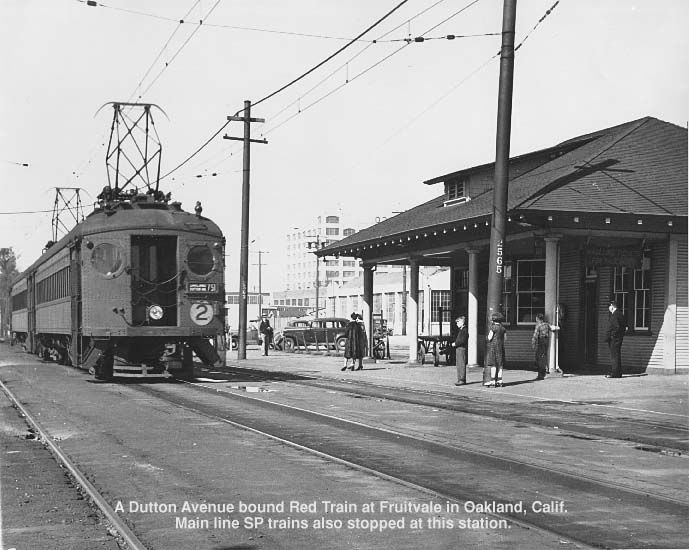
Southern Pacific Railroad Station at Fruitvale. Old
Montgomery Wards building in the background. From Google

TWO BOYS ROBBING SAFE
Police Detect Fads Fruitvale Railway Station OAKLAND, December 31, 1912
Patrolman Thornally and Special Officer Mason saw Fred Sheffield, I5 years old, and Maynard Cox, 17 years, at work at 2 o'clock this morning in the Fruitvale station of the Southern Pacific company, attempting to rob the safe. They had secured entrance by prying open a window with a jimmy. The youths were covered with revolvers and ordered to throw up their hands by Thornally and Mason. They started to run and Thornally fired a shot over their heads, stopping them. They were booked on charges of burglary.

PHONES BEFORE TRYING TO END LIFE; IS SAVED
Patrolman Finds A. H. Agard Lying in Bed With Gas Turned on and Drags Him Into Street
OAKLAND, May 9, 1913
A. H. Agard. 1315 Thirty-ninth Avenue, a searcher of records for many years, called up his brother, W. A. T. Agard of 2022 Woolsey Street. Berkeley, at 2 o'clock this morning to tell him goodbye before committing suicide. Agard, said that he had tired of life and had decided to end all. Agard's brother immediately notified the police, and Patrolman Thornally of the Melrose station hastened to the Agard home to find Agard lying in bed I with the gas turned on and the cracks and keyholes stuffed with rags. Thornally dragged Agard into the street and revived him. Agard's wife said, I recently left him because of family differences. She is now living with her parents at 1503 Fremont Street.
Sam's signature from his WWI registration form