Monday, December 2, 2019

James Edward "Ed" Pattillo 1913 - 1990 My Father - Part 2

Ed and Lottie on one of their two trips to visit Kathy in
Australia, 1979
Retirement and More Travel

Ed retired in 1976 at age 63. From then on, we had some fabulous trips together: Mexico with John and Hope in 1977, two trips to Australia – 1979 and 1985 including New Zealand, New York in 1980, the Panama Canal cruise to Puerto Rico with Flo and Andy and then we drove with them to Florida in 1983. Eastern Canada, Nova Scotia and Newfoundland 1983, Western Canada 1984, Florida Cruise and Epcot Center 1987, England, Ireland and Scotland 1988, copper Canyon Mexico and Texas in 1989. Also somewhere in between were two trips to the four islands of Hawaii. Those were our luxury trips – tour packages.

But in 1985 – August we bought a 1973 Winnebago motorhome – oh how Ed loved that. He was so excited about driving it. He’d wanted one for years but we never had enough money – so when I retired from Daughtrey's in April 1985, there was enough money in my retirement fund to buy our Winnebago for $9000 and enough for me to have all my kitchen cabinets refaced, new linoleum and new stove too. Wow! Were we happy then. 
Winnebago purchased in 1985

Took our first trip in it to Clear Lake. But our best one was to Albuquerque New Mexico for the Balloon Festival – oh how Ed enjoyed that – then Carlsbad Caverns, White Sands, Sedona and many more wonderful sights. Short trips to Kings Canyon and Sequoia National Parks, Lava Beds, Brookdale and Ben Lomond.

I always did the planning – but Ed and Terry too were always ready to go. He loved to drive and I loved to ride. He was a good driver and I always felt safe and content wherever we went.
Leukemia Diagnosis
Our dreams were shattered in May 1986. After a general physical at Kaiser Dr. Jensen Akula informed us that Ed had chronic leukemia. I was so scared! But Ed took the bad news calmly and went on living without complaint. He began to tire easily and was very confused at times – he’d forget how to get to Kaiser, or our friends’ homes, but he just did the best he could. I loved him all the more for his attitude and determination, although sometimes I was cross and impatient with him and now, I hate myself for being that way.

During his illness, Dr. Akula prescribed medication only three times. Kemo pills – Alkeran or melphalan. A ten-day dose seemed to bring his white blood cells down to a safe level. They ran from 21,000 to 43,000.
Kathy, Chris, Lottie, Ed and Terry celebrating Ed and
Lottie's 50th wedding anniversary, 1989
I am so grateful that we were able to celebrate our 50th (and 51st) wedding anniversary. First, we took a trip – a cruise that is to Alaska in June 1989. Jess and Cliff and Grace and Ernie were with us – also celebrating their 50th. After the cruise, Ed and I continued on to Denali National Park and Fairbanks. It sure had changed a lot since our first trip in 1965. Ed was pretty sick at times and tired easily, but even so, we walked all over Anchorage, Denali and Fairbanks. He was such a good sport and tried so hard to please me. It was a wonderful trip and I’ll never forget it.

And then best of all on August 1, 1989 Kathy came home for a one-month visit – her first in 19 years. Chris made the arrangements for her ticket and besides that she hosted a 50th party in her home for Ed and I and all our good friends on August 19th. What a feast we had – good drinks and dips, then fabulous turkey that Dianne barbecued. Chris made delicious salad and Kathy made my favorite dessert – Pavlova. Ed was still feeling pretty good so we had a super happy day. Everyone took pictures and brought lovely cards – for my scrapbook. I told Chris not to give us a party because she had given us one on our 25th and another on our 40th but I’m so glad she didn’t listen to me. The memory of that day with Ed and all our close friends will be with me forever. 
Ed, Kathy, Terry, Lottie, Walt Gunn and Ernie Moore
at the 50th Anniversary party.

Then we all went camping to Calaveras Big Trees State Park. Kathy rode and slept with Chris in her van – also Rookie. Ed and I, Terry, Ebony and Misty in the Winnebago. It was a happy four days for all of us – except Chris got stung by a yellow jacket. Jean and Walt spent an evening with us, Chris started drawing up our family tree, and we picnicked up at beautiful Alpine Lake, and spent our evenings playing Tripoli – our favorite game.

In October of 1989 Ed and I took an outstanding trip to Copper Canyon Mexico. It was a difficult and strenuous trip for Ed and he got pretty sick. We were home three weeks before he felt well again and began to eat. Then in mid-December he had a bad fall on the gravel driveway while helping Terry put up the Christmas lights.

Ed sitting in his chair with long time friends Al, Cliff
Gossett and Ernie Moore.
After that his condition went downhill. There were more falls and he was very confused – poor sweetie. On January 4, 1990 he entered Kaiser – against his will. I felt so badly – I didn’t want to leave him there but the doctor wanted to do some tests. He was there a week. Test results showed previous strokes and a small clot on the brain. Dr. Akula and his co-doctors said the damage was permanent and no medication would be of any help. I was heartsick. They sent him home with the discouraging words – not to expect any improvement. Ed was in bad shape, hardly able to speak, ate practically nothing, not able to get dressed or do anything for himself. Kaiser home nurses came but advised me to place him in a nursing home. I knew I couldn’t do that without first trying to care for him myself. So, with determination, patience and a lot of T.L.C. I brought him back to a reasonably healthy man. From wheelchair to walker to cane and even walking alone. We began a new and even closer life together. 
Lottie and Ed on one of their trips to Hawaii, 1980s
We went for drives in the car, shopping for groceries, lunches at Southland, a couple of shows and nicest of all two camping trips. In April 1990 we spent four happy days at Millerton Lake and in May we celebrated Ed’s 77th birthday and Mother’s Day for another four days at Del Valle Reservoir. Chris and Dianne came to spend a day with us too. I was so grateful – I didn’t think I’d ever have this chance.
Things went well – his appetite improved – he gained weight. Shaun and Sandy arrived March 11, on a round the world trip – they cheered him up and joined us on our rides to get acquainted with California. Then they were off to Wyoming for two months with Larry – returning mid-June. Ed was doing really well at that time and I was ecstatic – even able to go up and down a few steps.

About the end of June things got bad again ….. Ed did not respond to treatment and each day he slipped a little farther away from me. On September 3, 1990 at 6:15 PM while we were listening to the A’s ballgame, he closed his eyes and took his last breath. I knew I was going to lose him, but even so I wasn’t ready to let him go. I miss him so very much. Every day I told him I loved him and he always responded “I love you too” even though sometimes he just moved his lips, nodded his head or squeezed my hand. 
Lottie, Ed and Chris with Rookie and Misty, ca. 1984

We held his memorial service at Chapel of the Valley on September 7th. Chris gave a wonderful eulogy honoring her Father. The chapel was filled with our good friends who loved and respected him. He was buried in Mountain View Cemetery in Oakland. It’s a pleasant spot with a big shade tree and a view of the bay and San Francisco skyline on a clear day. The opposite view of green slopes with magnolia, fir and other varieties of trees, and is dotted with the headstones of other loved ones.

He’s been away from me for two and a half months, and I’m still so lonesome for him. He was such a quiet guy, but he was always there whenever I needed him. I know I’m lucky that we had 51 happy years together, but I wish we could have had more. 

So now I’m trying to put my life back together and begin a new chapter. Ed always said “It doesn’t do any good to cry about it” and I know he’s right but it isn’t easy. I know I’m very fortunate to have Terry here with me and Chris just a phone call away. I’ll always have my memories and now I’m trying my best to move ahead without my sweetheart.
Ed as a toddler

Ed’s Life Before Lottie by Chris
James Edward Pattillo was the eldest son of Lewis and Anna Pattillo. He was born in Los Angeles on May 10, 1913. When he was about five years old his family moved to Fresno and lived in a house at 1245 Iowa Street. Two years later when the 1920 census was taken they had moved to 3512 Tulare in Fresno. Ed attended Jackson Elementary School in Fresno. Then his family relocated to Oakland where he graduated from Alexander Hamilton Junior High on June 12, 1927, and Fremont High School on December 12, 1930. He earned a School Seal on his diploma signifying a minimum average scholarship of 1.9, and a conduct record of 105 points. This was the second highest ranking in his school. He was one of 31 to get this acknowledgment in a class of 148. He was also an honor roll student. Only 40 of 148 students in his class made the honor roll. 
Ed as a young boy
Between junior high and high school the Pattillo family moved to 1310 49th Avenue. After graduating from high school dad took a job as a truck driver for Signal Oil Company. On September 20, 1938 Ed and Lottie became engaged. By September 1939 dad had switched to Texaco Oil Company still working as a truck driver and in March of 1942 he was driving for Sunshine Biscuit Company. The rest of Dad’s story is in Mom’s narrative above.
Dad always had a garden and grew much of what we ate
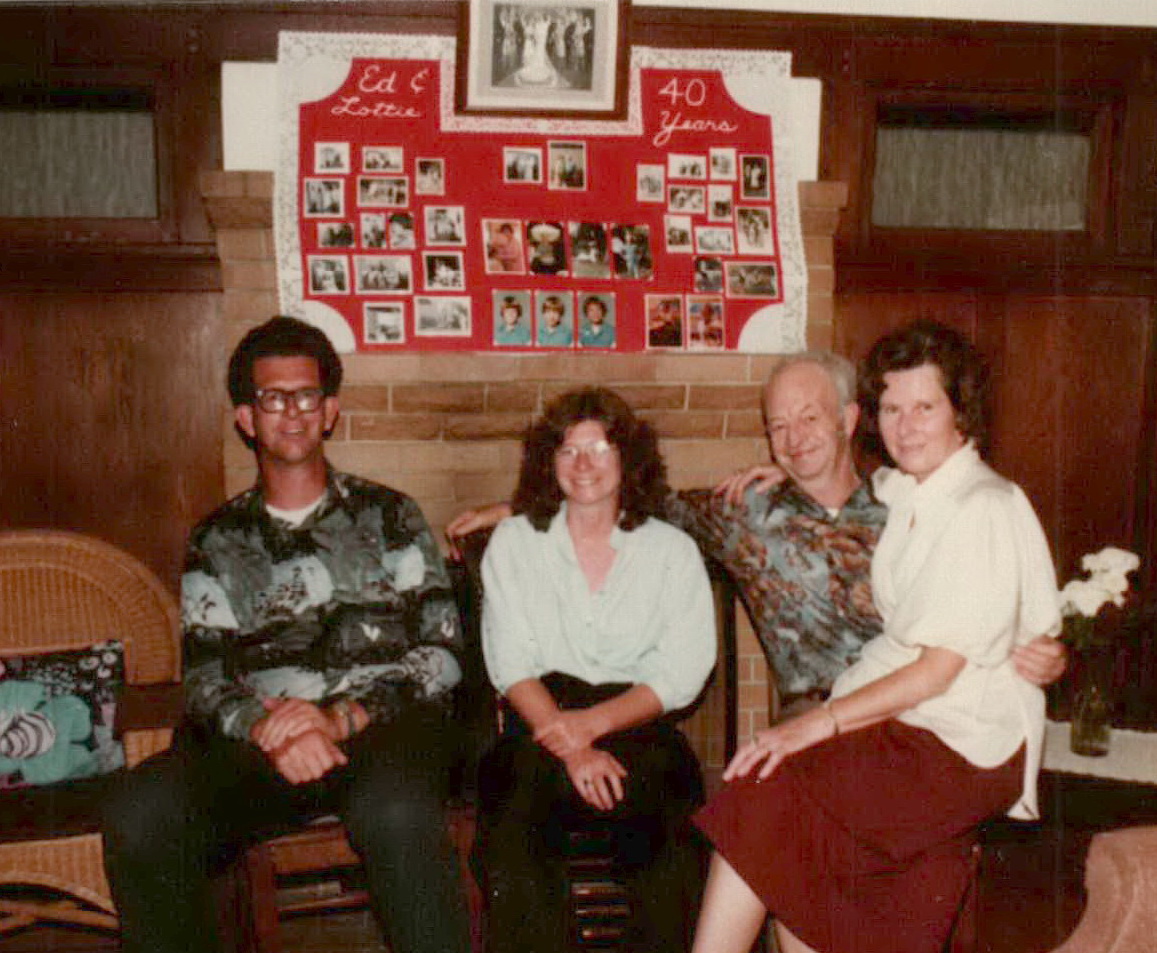
Terry, Chris, Ed and Lottie at Chris's home to celebrate Mom
and Dad's 40th anniversary, 1979

Ed, Jess and Cliff Gossett - lifetime friends

Lottie and Ed celebrating their 25th wedding anniversary, 1964

Their 40th anniversary

Ed with daughter Kathy and three grandsons Eric,
Shaun and Loren, 1979

Ed and Lottie with friends Flo and Andy Anderson on
 cruise to Panama Canal, 1982

Ed, Lottie, Jessie and Cliff celebrating their 50th anniversaries
on a cruise to Alaska, 1989

Tuesday, October 15, 2019

Mary Gilliat 1821-1882 My 2nd Great Grandmother on my Mother's Side

St. Peter Church in Thorpe St. Peter where Mary was christened
Mary Gilliat was the wife of Samuel Thornally Jr. and the mother of nine or ten children. She was the daughter of John Gilliat and Susanna Abraham. Mary was born in 1821 in Thorpe St. Peter, England and she was christened there on September 8, 1821. She was one of eleven children and the second daughter of John and Susanna. Mary’s older sister Henrietta was born in about 1817 and her older brother Abraham was born about a year later. Her younger sisters were Betsy born about 1822, Ann 1824, Elizabeth, who was known as Eliza, 1829, Harriet 1832 and Susannah, presumably named after her mother, born in 1834. Mary also had three younger brothers Alfred 1824, William 1827 and John 1833. John Gilliat was a farmer so it is likely that Mary and her siblings helped with the family farm as they were growing up.
A portion of the 1841 census showing Mary on the second line and
her siblings Henrietta, Betsy, Alfred and Ann
Mary’s family lived in Thorpe Hall in Thorpe Parish in Spilsby, Lincolnshire which is about two miles from Wainfleet. She appeared on the 1841 census for Thorpe St. Peter where she was listed with her siblings including Henrietta – both were shown as being twenty years old. Most likely this was a recording error on the part of the census taker. Their address was noted as being in the East Fen Allotment. In 1872 Thorpe had a population of 649 residents and occupied 2880 acres of land of which a large portion was fens (marshy areas). Thorpe was referred to as a scattered village and parish and still had a Lord of the Manor at that time.
This map shows the county of Lincolnshire and the
location of Thorpe St. Peter where Mary and Samuel
lived.
When Mary was sixteen Victoria assumed the throne of Great Britain when her uncle William died. Queen Victoria reigned for the remainder of Mary’s life. It was a time of “significant social, economic and technological change, which saw the expansion of Britain's industrial power and of the British empire.”

When she was twenty-two Mary married Samuel Thornalley Jr. and they established their home in Thorpe. Their first child, a daughter Mary Ann was born on August 23, 1846. Next was Samuel 1847, Susanna Ellen 1848, William Gilliat – my great grandfather who was born in 1850, Emma Marie 1851, Hepzibeh 1853, Betsy 1855, John Henry 1857, and Eliza 1859. Some records list a tenth child Kate born in 1864. So, Mary was pregnant for much of the time between the ages of 24 and 43.
This is the 1851 census showing Mary, now married to Samuel Thornally
and four of their children - Mary Ann, Samuel, Susanna Ellen and Gilliat,
my great grandfather.
In 1851 when the census was taken Mary was living with Samuel and their first four children. Ten years later they had moved to West Ham and were living at 249 Culbert Road in Plaistow, England. In 1867 her father died and the following year Mary’s husband Samuel died on January 27, 1868 when Mary was 47. 
The 1861 census shows Samuel and Mary living at 249 Culbert Road in Plaistow, England

The 1871 English censuses list a Mary Thornley as a patient at Islington West Trinity. In 1881 I found a widowed dressmaker living in Thorpe  at No. 15 Quadrant Road in Pancras, London. Though the name was spelled differently the age jibes with our Mary so it is possible that she supported herself as a dressmaker after Samuel died. Mary’s mother died in 1878 and Mary died a few years later at the age of 61 while living in Pancras. During Mary’s lifetime, Charles Dickens wrote Oliver Twist, slavery was abolished in the British empire in 1838, a uniform one cent postage rate was established, the world’s first municipal park opened in Birkenhead near Liverpool, and the Crimean War began.
Two screen shots of Pancras from Google earth


Sources for the Post: 1841-1881 English census, marriage and Christening records for Mary and her children, Sue Tucker's family tree.


Saturday, September 21, 2019

Samuel Thornalley Jr. 1822-1868 My Second Great Grandfather on My Mother's Side

This is All Saints Church in Wainfleet St. Peter where Samuel
was baptized
Samuel Thornally Jr. was my grandfather’s grandfather. I have six Samuel Thornally’s in my database, so obviously it was an important family name. This Samuel was the son of Samuel Thornally and Susanna Dennis Coates. He was born in the village of Wainfleet St. Mary which is in Lincolnshire on the east coast of England about 100 miles north of London. Both Samuel and his father were brick and tile makers and this fact had a profound impact on the Thornally family.

Samuel Jr. was christened on June 9, 1822 so he was likely born just few days prior to that date. His christening was recorded in the parish records of All Saints Parish as were those of his siblings. Samuel Jr. was the second child born to Samuel and Susanna. He had one older sister Eliza who was born in 1821. His younger siblings were: John born 1825, Joseph 1826, Abraham 1828, Elizabeth 1829, Ann 1830, Benjamin 1831 and Susanna1834.

This shows the location of Wainfleet St Mary where
Samuel was born and lived before moving to the
London area
I don’t have any records about Samuel as a child but we can assume he had some educational training and very likely went to work in his father’s business while still quite young.

When he was 21 Samuel Jr. married Mary Gilliat on August 8, 1843. The ceremony took place in St. Mary’s Church in Wainfleet. Mary was born in nearby Thorpe St. Peter also in Lincolnshire. She was the daughter of John Gilliat and Susanna Abraham and 22 at the time they were married. Between 1846 and 1864 Samuel Jr. and Mary had ten children.

When the English census was taken in 1851 Samuel and Mary were living in Thorpe St. Peter at No. 7. Samuel was listed as the head of the household, age 28 and employed as a brick and tile maker. He would have been working in his father’s brick and tile making business. Mary was 29. They had four children at that time – Mary Ann aged 6, Samuel 11, Susanna Ellen 2 and my great grandfather Gilliat 9 months. There were five additional people living at No. 7. They were William Davy aged 15 and identified as an agricultural servant, Ann Marshall age 16 – a house servant, Charles N. Parker a 21-year old lodger and tile maker, William Elerby also a lodger aged 29 – a pipe tile maker, and Richard Gilliat identified as a Relation, aged 29 and employed as a tailor. This suggests that Samuel was well off – he had two live-in servants and two live-in employees. 
Google Earth view of Thorpe St. Peter - the small village
where Samuel and Mary Thornally lived

The following year, on 28 May 1852 The Lincolnshire Chronicle and Northampton, Rutland and Nottingham Advertiser ran this story under the title “Thorpe Culvert”. It read: “Samuel Thornalley, Boatman and Corn Salesman, at Boston and Lincoln, returns his sincere thanks to his friends and the public for the very liberal encouragement he has received in the above Business, and respectfully informs them that he has now retired from the same in favour of his son Samuel Thornalley Jr., for whom he solicits a continuance of their support. Samuel Thornally, Jr., begs to assure the coustomers of his Father and the public generally that nothing on his part shall be wanting to merit the support so liberally bestowed on his predecessor. Salt and rock salt shall be regularly supplied. The brick and tile making business at Thorpe will also be carried on by S. Thornalley Jr. A large assortment of flower pots constantly at hand. S. Thornally Jr. will attend the neighbouring Markets and will deliver Bricks, Pavings, Pantiles, etc. at Boston to order.”[1]
Street view of Thorpe St. Peter


A year and a half after inheriting the family business Samuel’s father died on January 9, 1854. Samuel Sr. had written a will in which he left everything to his wife Ellen whom he married after the death of his first wife Susanna. He named his eldest son Samuel Jr. as one of the executors of the will. Very regrettably, there was a major disagreement regarding the terms of the will between Samuel Jr. and one of the other executors Richard S. Burn. As a result, Burn filed a lawsuit naming Samuel Jr., each of his siblings, his stepmother and brother-in-law as parties to the suit. In his article Brian Thornalley explained that “It boils down to Mr. Burn trying to do his executor’s job properly (as he saw it), by asking Samuel and two of his brothers, all three of them owing considerable amounts to their father’s estate, to pay up, so that debts could be settled and the affairs wound up. They argued that their debts were less than their expected shares from the will, so they wanted the one set off against the other.”
The Royal Oak in Thorpe St. Peter - note all the brick buildings


Brian goes on to explain, “The case went to the High Court of Chancery in 1855. The National Archives at Kew have supplied copies of all the case papers – the Bill of Complaint, by the Plaintiff (Burn), the `Interrogatories for the Examination’ (i.e. The Court’s questions), and the `Answers’ of the Defendants.

Frustratingly, the Judgement is not available, not even in the National Newspaper Archive, as far as Brian could find, but it is perfectly clear that the Thornalleys lost the case, because, by February 1857, in The London Gazette and the local Lincolnshire newspapers, pursuant to a Decree by the High Court of Chancery there was announced the sale of the `desirable freehold estate, containing altogether 23 acres, 12 perches or thereabouts, situate in Stickney, Irby and Thorpe, at the George Inn, Spilsby, on 2 March 1857. That is to say, everything, lock-stock-and barrel, that his father had handed over to Samuel Jr. in 1852.”
Aerial view of Spilsby where Samuel registered to vote in 1852

The notice in The London Gazette listed the property to be sold - it included five lots as follows.
              Lot 1 – In Stickney. A messuage (a dwelling house with outbuildings and land assigned to its use), barn, stable, and buildings, with a close of rich pasture land, orchard, paddock, stockyard, and garden adjoining, lying on the east side of the West Fen Side-road, and containing 4A. 1R. 30P. (This is some form of measuring land.)
              Lot 2 = In Stickney. A close of arable land with the ash holt in the corner thereof, lying on the west side of the said road, and containing 4A. 1R. 26P. “Close” is another form of measurement.
              Lot 3 – In Irby. A close of arable land, called the common, a close of meadow land, and a close of arable land, containing altogether 6A. 1 R. 26P.
              Lot 4 - In Irby. Two closes of arable land, called Millhill Close, and the common, containing together 4A. 3R. 14 P.
              Lot 5 – In Thorpe. A messuage and buildings, two claypits, brick-yard, and poplar bolt, containing 2A. 1R. 27P. Lots 1 and 2 are occupied by Mr. Richardson, and lots 3, 4, and 5, by Mr. Samuel Thornalley Jr. 
George Hotel in Spilsby

Brian wrote, “Samuel’s future was in ruins. It looks as though he suffered the full effects of the family disaster. He placed a notice in the local press to say that, by indenture dated 12 March 1860, he assigned all his personal estate and effects to his brother Abraham (brick-maker) and John Parker (yeoman) for the benefit of his creditors. Samuel left Lincolnshire, probably in disgrace, worth nothing, and probably without the sympathy of his siblings, their wives or husbands, his father’s widow and his half-brother, now aged twelve.” 
A commercial building in modern day Thorpe St. Peter
Brian Thornalley offered no explanation as to why Samuel Jr.’s siblings blamed their brother for the disastrous outcome of the lawsuit. Did they feel Samuel Jr. as executor had the ability and responsibility for selling the family property and in not doing so created the liability? The terms of Samuel Sr.’s will “directed that his real estate, rents and other property be sold and the proceeds be invested in stocks or funds of Great Britain or government or real securities in England after paying debts, funeral costs and taxes owed. They were to collect the profits from the rents and other investments and pay Ellen (Samuel Sr’s. widow) 30 pounds sterling a year and pay to support his children until 6 April 1862. After this date sell everything and distribute it to his children. If Ellen dies or remarries her 700 pounds goes into the estate. The children receive their share when they turn 21.” 
Churchyard behind Wainfleet St Mary Church
St John Church in Hampstead where
Samuel was buried
It may be that Samuel Jr.’s siblings blamed him for failing to follow the terms of the will that stipulated that he was to sell everything, pay off the debt and invest whatever was left. Brian’s article notes that there was disagreement over the value of the property but one would have expected Samuel Jr. to compromised instead of losing everything.

By 1861 Samuel Jr. moved his family to the London area and took a job as a foreman brick-maker. On the 1861 census he and his family were living at 249 Culbert Road in West Ham, Plaistow, England. They had seven children living with them aged twelve to one year. Ann Kidd a dressmaker from Irby, aged twenty-five was also listed in the household when the census was taken.

At some point Samuel and Mary relocated to Belsize-Square, Hampstead four miles northwest of London where Samuel died on January 27, 1868. He was only 45 years old and should have been in his prime. A summary of his will noted “effects under 100 pounds.” With inflation factored in that would be equal to $11,214 today – very little money to support a wife and six children between the ages of four and sixteen.

Samuel was buried on February 2, 1868 at St. John Churchyard in Hampstead. I found a written record of his burial there but he is not listed in the online parish record for the church.
This shows Samuel Thornally buried at St John Church in Hampstead,
county of Middlesex, England
This is a tragic story – something rare within the ranks of our family. Generally, the information I have been able to discover during my years of research includes mostly good fortune suggesting stable and in some cases above average success. There have been many entrepreneurs in our family on all branches of our family tree. Most of these businesses have been successful and their descendants have benefited. Clearly, Samuel Sr. did well for many years and was able to acquire considerable property in three different villages that he derived income from. From reading a little about British economic history I find no clear reason for Samuel Jr.’s misfortunes. There is mention of a recession that began in 1840 but it seems unlikely that would have caused a depression in the value of the property owned by the Thornally family that would have persisted until 1855.

Fortunately, Samuel’s son Gilliat who immigrated to Oakland via New York and San Francisco and went by the name William Gilliat Thornalley was able to renew the family fortunes by acquiring and developing property in Oakland. He and his sons and surviving daughter Rose Mary were all successful to varying degrees. 
Interior of St. John Church

The churchyard at St. John Church


[1] Brian Thornalley researched and wrote about this branch of our family and published an article in Lincolnshire Past and Present titled, “Samuel Thornalley – from first to last”

Sources For This Post: Article by Brian Thornally, news ads about the court case, 1852 poll book, census records, information provided by Sue Tucker, marriage records provided by Randy Thornally, christening record found on FamilySearch, and a burial record for Samuel. 

Wednesday, September 11, 2019

George Vetter 1885-1913 My Great Grandfather on My Father's Side


George Vetter - probably on his wedding day
My paternal great grandfather George Vetter was born in Germany in a village called Bechtheim. He was born on May 14, 1858 and christened in the Catholic Church. George was the fourth child of Johannis Vetter and Catharina Ruth Bassemir. He had three older sisters and one younger brother. His sisters were Elisabetha Vetter born in 1850, Barbara Vetter born in 1852 and Catharina Margaretha Vetter born in Bechtheim in 1856. His brother Phillipus Jacobus Vetter was born in 1863.

Bechtheim is a small market place in the county of Worms, the province of Rheinhess, and the Kingdom of Hessen. It is located southwest of Frankfurt and is twenty miles southwest of Darmstadt. In 1912 the population was 1452 and by 2008 it had only grown to 1833. Bechtheim is best known for producing wine.
Historic map of Bechtheim where George was born

George was born during the time period when Germany was rapidly changing due to industrialization. He was thirteen in 1871 when the German Empire was created by the unification of what had been many independent states, so the country was undergoing dramatic change that undoubtedly would have impacted his family.
Google street view of Bechtheim today
In 1881 a passenger list I found suggests that George made a trip to the United States. He was on board a ship called Prague that left Hamburg on November 29th and sailed to the United States via Glasgow after making a stop at the Port of Leith in Edinburgh, England. That is all I really know about that trip but it is likely that George made the voyage in order to explore opportunities he might have if he chose to immigrate to the United States.

Map of Mainz north of Bechtheim where George and
Katherine lived before they immigrated
By 1883 George was living in Mainz – a larger city in Germany 18 miles north of Bechtheim.  It was there that he married Katherine Neumayer on February 23, 1883. He was twenty-five at the time. Katherine was from Wattenheim, Germany which is about 17 miles southwest of Bechtheim. Their marriage record shows that George was employed as a stonemason and that his father was a miller. It identified both George and Katharine as being Catholic. In addition to their marriage record I found George and Katherine listed on the Family Register for Mainz. Every family in Germany was required to register whenever they moved so it is a good source of genealogical information.

Just five months after they were married George and Katherine immigrated to the United States. From their marriage record I know that George’s father and both of Katherine’s parents were deceased at that time, so they would not have kept them from leaving Germany. On July 25, 1883 George and Katherine were passengers on a ship called France. I don’t know which German port they departed from but it was probably Hamburg – the same port that George had used previously. They first went to London and from London to New York. They left Germany during the peak of one of the largest and last big migrations of Germans. It was also a time when wages in Germany were depressed. Their final destination was Chicago which attracted the second largest number of German immigrants after New York City. According to the 1900 Chicago census George immigrated to the United States in 1892 which was between his first trip to the US in 1891 and when George and Katherine came over on the France.
George, Katherine and their daughter Kate

A little more than a year after they were married their first child was born on May 13, 1884. It was a daughter that they named Augusta. Sadly, this child died just five months later on October 16, 1884. They also used the name Augusta as their third child Mary’s middle name, so it is apparent that this is an important family name. So far, I have found no Augusta’s in either George or Katherine’s families so I do not yet know what the connection is.

By 1887 George and Katherine were living at 562 W. 12th Street in Chicago and George was working as a “steinhauer” or stone cutter. That year there were twelve other Vetters listed in the Chicago directory with professions that included a cabinet maker, a midwife, two laborers, a music teacher, a butcher, a furrier, a reverend, a tailor and an engraver. Some number of these individuals were likely also German immigrants.

The 1900 census notes that George had not yet been naturalized to become a US citizen, and the question was left blank on the 1910 census so it is possible he never was naturalized and remained a German citizen though that seems unlikely. Between 1885 and 1893 George and Katherine had five more daughters. For details see Katherine’s bio on this blog posted in August 2013.
George with his five daughters L-R Mary, Elisabeth,  Anna, Kate and Emma
Several years ago, I was contacted by Bettina Horsch a scholar who was writing a book about the Standard Brewery in Germany. She found me from an article I wrote about George that was published by the California Genealogical Society Newsletter. I helped her by sharing what I knew about George and sent her a couple of historic photographs – one of which showed George standing in front of his saloon. To thank me for my help she made copies of the Chicago directories during the time period that George and Katherine lived there. These provided valuable information about where they lived at different times. In the 1890-94 directories they were listed at 1328 W. 20th. In 1895 George was listed as a saloon owner/manager and they were living at 747 W. 20th. This is the same address as the saloon so as was typical at that time, the saloon would have been at street level and the residence above.
The building on the left, behind the light pole, is a Standard
Brewery Building
In 1896 he was listed as a painter living at 890 W. 21st Street. There were no entries for George for 1897 or 1898 but in 1899 he was listed at 873 W. 21st and the listing just said “coal”. Between 1900 and 1906 they were living at 409 21st Street. George was shown as working in a hardware store in the 1901 – 1903 directories and as a traveling salesman in 1906. George’s wife Katherine died in 1903. 
One of many directory listings I have for George. This one shows that he
was working as a stone cutter and living at 562 W. 12th Street in Chicago
So, during the twenty-two years that George lived in Chicago he lived at several different addresses but they seemed to be relatively close together being mostly on 20th and 21st Streets in the west side of Chicago. George also had many different types of jobs – from stone cutter to saloon owner, hardware store employee to traveling salesman. Despite these multiple professions, I think of George as a saloon keeper because of the photos I inherited from his daughter showing George in front of his saloon.
George standing in front of his saloon. You can see his name Geo. Vetter in
the window and Beer Hall, Wines, Liquors and Cigars
After 1906 George was no longer listed in the Chicago directory which suggests he moved elsewhere. I have found no trace of George between 1906 and 1910 when he appeared on the census living in Pasadena, California. According to his youngest daughter, my grandmother Anna, George was not much of a father after his wife died. Anna was ten when her mother died and she always said that it was her older sister Kate who raised her. Indeed, Anna was living with Kate in Rhyolite, Nevada when the 1910 census was taken, but she was living with her father in Pasadena when she got married the following year. Each of George’s five daughters were married between 1909 and 1912.
Another photo of George in front of his Chicago business
On December 3, 1910 when he was 53 George married Nellie Gregory at the Vicarage in Garvanza. It was the second marriage for Nellie whose first husband was a Gilbert. She was born in Illinois on July 10, 1863. She was still living in Illinois when the 1900 census was taken but was in Los Angeles by 1910. Their marriage license indicates that George was employed as a gardener at that time, so he had reinvented himself once again.
Newspaper notice of George and Nellie's wedding
Before writing this biography, I looked for each of George’s known addresses on Google Earth but I was unable to find any of the properties where he had worked or lived. Each of the addresses had either been redeveloped or was vacant in 2019. I could tell that the neighborhood where George and Nellie lived on Redwood Drive in Pasadena was very similar to the neighborhood where I now live in the Montclair neighborhood of Oakland – hilly with a mix of architecture styles of single-family homes.
Death certificate for George
George and Nellie’s marriage lasted almost exactly three years until George died from stomach cancer on February 18, 1913. His death certificate indicates he was buried at Rosedale Cemetery in Los Angeles County but I have not found a headstone for him.
Church of the Angles in Garvanza. I think this is where George and Nellie were married

Map of Germany showing Mainz top left and Darmstadt.
The town of Bechtheim is just above the "oo" in Google
at the bottom.

Blow up showing George on the wagon

Aerial view of current day Mainz

Street view of Mainz

Mainz

Mainz

Close up of the detail on the Standard Brewery building

The Standard Brewery bottle
Sources for this Post: Census records, death certificate, historic newspapers, Anna Pattillo's bible notes and stories, family photos, city directory listings, marriage records, ships lists, German Civil Register, birth records for George's daughters, and Chris Dixon who is somehow related to Elisabeth Vetter.