Tuesday, August 27, 2019

Fred Menge 1890-1973 My Grand Uncle on my Mother's Side

Fred Menge as a young man
Hugo Friedrich “Fritz” Menge was born in Hildesheim, Germany, where his mother Elisabeth Stolte was from. He was born on June 6, 1890, and was baptized at St. Magdelena Church in Hildesheim. He and his family returned to California in 1891, where he would be known as Fred. I don’t know why the family went to Germany for a visit at that particular time, but I do recall that my grandmother Emma went with them — the only time she was in Germany.

Fred attended school in Oakland but only through the fifth grade. When he was 20 Fred spent some time in Seattle, Washington. I found him on the 1910 census, living at 518 Virginia Street. He was a lodger along with five other men in a house owned by Gottlieb and Minnie Topp. All six men were in their 20s and were from Germany. Four were sailors and the others were tradesmen like Fred, who was listed as a truss maker working in a truss factory. My guess is that this was part of a training program, but I don’t understand why he did
Fred holding the parasol with two friends
not simply stay home and learn the trade from his father.

The Oakland City Directory tells us that Fred was living at 1833 San Pablo Avenue in 1912 and that he was working as a salesman for his father or brother at the Oakland medical aids shop. So he was back in California after being in Seattle. In 1916 he was working as a truss maker at 718 Washington in Oakland.

On June 16, 1913, it was reported that Fred was arrested for speeding in Oakland while riding a motorcycle. The news article reported that a total of 18 were arrested and seven were riding motorcycles. I think that included our Fred, so it seems Fred had a bit of a “wild” side to him.
On April 6, 1916, Fred married Beulah A. Trexler, with whom he had four children: Fred Vernon Menge, born May 29, 1917; Robert W. Menge, born about 1920; Marjorie G. Menge, born September 16, 1921; and Ralph Henry Menge, born April 14, 1923.  The family lived in San Francisco in 1920, but between 1922 and 1943 they owned a home in Oakland at 3225 East 17th Street. Today, that lot is occupied by a commercial building.

Fred was 27 when he registered for the draft in 1917, during World War I. He was described as five feet, ten inches tall, slender, with light blue eyes and light hair. 

A portion of Fred's draft record 

Fred was a self-employed truss manufacturer from 1917 to 1930. He had a shop in San Francisco at 2814 Mission Street. In the 1921 Oakland City Directory he was listed as President of Menge Truss Company, so he was in direct competition with his father and brother. Then in 1926 he was listed as a manager at M&P Surgical Appliance Company. By 1930 he was a manager at the Pacific Truss Company, which was located at 904 Broadway in Oakland. I wonder if this might have been Heinrich’s business? From 1933 to 1937 Fred’s business address was in Hayward at 2867 Mission Boulevard, but he was still living in Oakland during that time.

Beulah and Fred from Janet
Fred and Beulah divorced on October 23, 1936. The final divorce decree said the grounds were “cruelty,” although it did not specify who the victim was. 

Fred again registered for the draft when he was 52, on April 26, 1942. That was pretty old for military service, but it was four months after the United States entered World War II, when all men aged 18 to 64 were required to register. His registration described Fred as five feet, ten inches tall, 156 pounds, with a light complexion and a scar on the first finger of his left hand.
Fred taken at his sister
Emma's home

I found no information about Fred during the next 30 years of his life. He died on November 22, 1973, at the age of 83, and is buried at St. Mary’s Cemetery in Oakland, in plot Y. There is no headstone for Fred.


Fred standing at the left next to John Thirbakkt

Fred with his son Freddie

3 of Fred's children - Marjorie, Bobbie and Freddie

Fred's son Bobbie

Fred's daughter Marjorie

Marjorie as a senior, posted by her son Daniel

Sympathy card from Gertrude Menge, one of Fred's nieces
Fred's obituary

Fred's granddaughter Janet with the author in 2017
Sources for this Post: Archive newspapers, census records, draft info, family stories and photos, birth record from Germany, social security death records, cemetery files, voter registration files, and City Directories.

Sunday, August 18, 2019

Henry Menge Jr. 1886-1965 My Grand Uncle on My Mother's Side


Henry George Menge Jr. was born March 17, 1886, after the Menge family moved to Oakland and were living at 1153 7th Street. Henry was identified as an apprentice truss maker on the 1900 census when he was only 14 years old. It did not indicate that he was in school at that time, so it seems his father had taken him out of school and put Henry to work which was common at that time. Henry’s daughter Dorothy told me that Henry only attended school through the sixth grade.

On May 23, 1908, when Henry was 22, he was an officer of the La Belle Jeuenesse Dancing Club.  According to an article in the Oakland Tribune, Henry was in charge of several men and women who were planning a club event at the home of Mrs. Nellie Melquoind at 1807 Russell Street, Berkeley. Almost exactly one year later Henry married Maye Loella Best. Perhaps she had attended the dance club event and met Henry there? In April of 1910 Henry and Maye were renting a home at 520 8th Street in Oakland and he was president of the Pacific Truss Company.

Henry as a toddler with his sister Emma
The 1930 census lists Henry as a veteran who fought in the ten-week-long Spanish-American War. I agree that Henry served in the U.S. Navy because of the photo of him in uniform, but he would have been only 12 years old in 1898, when the Spanish-American war was waged, so that seems improbable that he served in that war. Henry registered for the draft when he was 32, during World War I. He was described as five feet, eight inches tall, with a slender build, blue eyes and light brown hair.

Henry and Maye had six children and adopted or fostered several others. Their firstborn died at birth and is buried at St. Mary’s Cemetery with his paternal grandmother and four other relatives, including his cousin John Earnest Thornally. In 2015 I had a headstone made and installed for these family members. The next four children were daughters Margaret, Dorothy, Marion and Audrey, all born between 1911 and 1918. My mother Lottie was very close with these cousins and spent a lot of time with them. She borrowed Dorothy’s veil for her wedding, and Marion was one of her bridesmaids. Henry and Maye’s youngest child was a son named Lawrence. 
Three of Henry and Maye's children - Dorothy, Marion
and Margaret

In the 1914 and 1915 directories, Henry was listed as working with his father in San Francisco. This surprises me, because the business had been destroyed in the 1906 earthquake and fire. They must have rebuilt in San Francisco by 1914, when they were located on Kearny.  By 1918 they had opened a shop in Oakland and Henry was working there. I also found listings for the Pacific Truss Company in San Francisco and Oakland in the 1922 and 1926 directories.

Henry seems to have shared his father’s civic-mindedness. On May 11, 1916, he was one of several men who organized a whist party at the Lakeside Hall on East 12th Street at Sixth Avenue in Oakland, as a benefit for the Day Home of West Oakland. This facility was operated by the Sisters of the Holy Family. In 1930 Henry was part of a Melrose Church group that planned a dance as a benefit for St. Bernard’s Church. The dance was to take place on November 14, 1930, at Melrose Central Hall on 48th Avenue at East 14th Street in Oakland.
Two photos of Henry's son
Larry


I found four addresses for places that Henry and Maye lived between 1912 and 1941, including 4110 Aqua Vista, 6109 Hayes, 600 Haddon Road, and 425 E. 15th Street. The latter is a place that Mom and I visited when she was helping me with our family history.
Henry and Maye's home in the Fruitvale neighborhood of
Oakland

Henry died on February 3, 1965, and is buried with his wife Maye at Holy Sepulcher Cemetery in Hayward, California. Lottie very much loved her Aunt Maye and Uncle Henry, who she thought was a wonderful father and uncle. She said he was always very generous to her and willing to take her along on family outings. Henry and Maye also owned a cabin in Brookdale, as did Lottie’s father John. Henry’s cabin was still standing in 2013 when Mom and I drive drove to Santa Cruz, shortly before she died.
Henry and Maye's cabin in Brookdale
Maye Menge at a birthday party for Emma

Maye Menge

Henry's daughter Marion with Emma and Marion's husband
Geroge Heinkle

Henry's daughter Dorothy and his niece Lottie Pattillo

Henry's daughter Dorothy's wedding. L-R are Gertrude, Agnus,
Dorothy and Margaret Menge, Lottie Thornally, and Marion Menge

Audrey Menge

Dorothy Menge and husband Bill McTigue
holding Chris Pattillo on her christening day

Margaret Menge and her husband Whayne Gibbs
Sources For This Post: Interviews with Lottie Thornally and Dorothy Menge, family photos, US census, historic newspapers, military records, and city directories

Tuesday, August 13, 2019

Emma Louise Menge 1883-1982 My Maternal Grandmother

Emma Louise Menge - probably on her
wedding day

Emma Louise Menge was born in San Francisco on August 1, 1883. She was the daughter of Heinrich Friedrich (Henry) Menge Sr. and Elisabeth Stolte. Emma was christened in the Catholic Church on Golden Gate Avenue and attended school in San Francisco and Oakland. She had two younger brothers: Henry George Menge Jr. was born when Emma was two and Hugo Friedrich “Fritz” Menge when she was six. When Emma was eleven her mother died. A few months later her father married Edna Francis “Addie” Schlotzhauer. Emma did not like her stepmother because, she said, “Addie was not nice to me.” Emma attended school until about the age of 12, which would have been through about seventh grade.

Emma as a toddler
When Emma was 14, she, Addie’s daughter Dora, and Emma’s cousin Miss Bechtell supplied the programs for a charity event hosted by Emma’s father and stepmother. A story published in the San Francisco Call newspaper described the event as a “musical and garden party at the beautiful grounds and home of Mr. and Mrs. Menge at 1450 Fruitvale Avenue. The lovely grounds have been specially decorated and will be brilliantly illuminated in the evening.”

As a teenager, Emma worked for her father making trusses for his medical aids manufacturing and sales business. Heinrich had shops in San Francisco and Oakland. When the census was taken in 1900 Emma and her family were living at 233 Fruitvale in what was then the town of Brooklyn, later incorporated into Oakland. In addition to her brothers Henry and Fred, a three-month-old half-sister, Adelaide, was listed on the census. Adelaide was two when the census was taken and must have died shortly thereafter, because I have found no trace of her. My grandmother had never mentioned that she had a sister that had died young. 
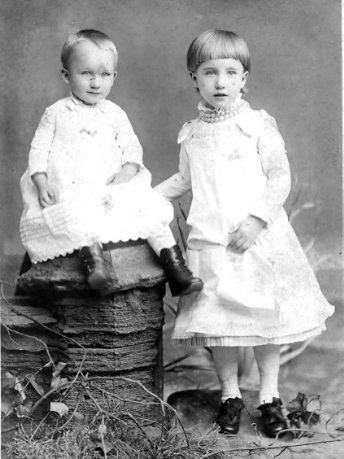
Emma has a young girl with her brother
Henry

On October 16, 1903, the Menges hosted another party that made the news. It was a surprise party for Emma’s cousin Pauline Walker. According to the Oakland Tribune, “The reception and other rooms were very prettily decorated with palms, pampas ferns, and Chinese lanterns. At a late hour, the grand march was led by the young folks to the banquet room.” Emma’s stepsister, brother Fred, and several other guests attended the event.

Just two months after the earthquake and fire that destroyed much of San Francisco in 1906, Emma married John Roger Thornally in San Rafael. A short newspaper article headlined “Marriage of Popular Couple” suggests they eloped. The report said their marriage “came as a great surprise to the friends of the popular couple.” I suspect that because of the San Francisco earthquake, Emma’s and everyone else’s lives were in chaos. Her father’s business had been destroyed, so the idea of having a fancy wedding would be out of the question. Emma’s brother Henry and his fiancé Maye were also secretly married in San Rafael three years later — probably for the same reason.
John Thornally and Emmas a s young couple

The 1906 newspaper article also mentioned that Emma and John would make their home on Bay Street in Alameda. This surprised me because all the other addresses I have for the family at that time are in Oakland. Between 1906 and 1922 Emma and John lived at 1665 35th Avenue. This is one of the single-family homes that were built by John’s brother in the Thornally Tract, which was purchased by their father and is where each of the Thornally children owned homes built by their older brother Will.

In July of 1909, when Emma’s brother Henry was married, a news article about the marriage mentioned that Emma and John were living at 1647 Redwood (now 35th) Avenue. Emma and John hosted a wedding reception for Henry and Maye at their home.

For some unknown reason, Emma and John had difficulty conceiving a child until Emma was 29, after which their son John Ernest Thornally was born on June 22, 1913. Very sadly, the baby died less than a month later. He is buried in Saint Mary’s Cemetery along with his grandmother Elisabeth Stolte Menge, a cousin and four other relations. The loss of this child was very difficult for both John and Emma.
Emma, John and their treasured
daughter Lottie G Thornally

It was six-and-a-half long years until Emma gave birth to their daughter, Lottie Gertrude Thornally, on Christmas day in 1919, by which time Emma was 36 — considered quite old to be a new mother. Fortunately for all of us, Lottie thrived and was treasured by both her parents. What I’ve never known until now is that “Gertrude” is an important family name. Lottie’s grandmother was Gertrude Elisabeth Stolte and at least three other of her ancestors in Elisabeth’s tree have the name Gertrude.

In 1922 John and Emma purchased their home at 636 Syble Avenue in San Leandro. It was in a neighborhood of one- and two-story bungalow-style homes. This is the home I remember fondly. The front yard was enclosed by an old-style wire fence. The central front walk went between two tall lemon trees and led to concrete steps that were red. There were camellia shrubs on either side of the steps. The front porch extended all across the front of the house but it was rare that anyone sat outside on this porch. The front door was heavy oak with a dark stain and small, square panes at the top. You entered into a combination living room to the left (west) and dining room to the right (east). The living room had a stiff-looking couch and a brick fireplace with bookcases on the side, although there were not many books on the shelves. An upright piano sat opposite the front door on the north side of the room; it had a single-seat stool that I liked to spin around on. A claw-foot, dark-stained oak table occupied the dining area, surrounded by oak chairs with upholstered seats. One chair had arms and it sat by the front window, where Gramma liked to sit and watch people and cars outside. She looked out through sheer curtains. There was a built-in china cabinet on the east wall next to the dining room table. I have owned the table and chairs ever since Gramma moved out of her home, and our family has continued to enjoy family dinners at this table for many years. It has five heavy oak leaves that expand the table, so it has always been sufficient to seat our entire family.
Easter Sunday Emma with her grandchildren - Terry, Kathy
and Chris in the backyard of Emma's home on Sybil
Opposite the front door there was a door to what had been Mom’s bedroom when she was growing up. I don’t recall much about that room. From the dining area there was a swinging door into the kitchen, which was large and square. The kitchen was the center of this home in more ways than one. The kitchen table sat in the middle of the room. Gramma and Grandpa had an old Wedgewood stove, and on one side you could heat the burner with a wood fire. Grandpa’s rattan rocker sat next to the stove, where I recall that he and I would take our naps. The wall opposite the stove had a long built-in bench seat. The seats of the bench were hinged so you could lift them up to reveal storage compartments. That is where Gramma kept toys, so I was in and out of there frequently. The kitchen sink and counter ran across the east side, and her kitchen windows looked out toward the home of the Kokinas, the Greek family that lived next door. The Wright family lived on the opposite side. I particularly liked Mr. Wright, who gave me peppermint candies.
Emma and her daughter Lottie standing
under the lemon tree in Emma's frontyard

Gramma and Grandpa’s bedroom was in the northwest corner of the house. I didn’t go in there much, but I do remember seeing their brass bed — another item of furniture that I inherited and used for many years. Next to their bedroom was the bathroom, with its great big claw-foot bathtub and a window that looked out into the backyard. There was a small space between the kitchen and bathroom that was always very dark.

From the kitchen you could walk through a small laundry room with its old-fashioned ringer washer to steps that led to the backyard. Gramma was very worried that I would somehow get my fingers caught in the ringer and more than once warned me to keep away from the machine.

The stucco-finished home had a small basement area where Grandpa spent a lot of his time on projects. He had a few tools, a workbench, cupboards, and an old wine or beer barrel in the basement. The garage was detached and could be accessed by a two-track driveway on the west side of the house. There were more camellias on that side of the house, and raspberry vines between the driveway and Mrs. Wright’s home. I don’t recall that the garage ever had a car in it. Instead, it was filled with machinery, tools and myriad jars and cans of nails, screws, washers and other items so mysterious that I still don’t know what they were for. Grandpa used all this to make and repair things. He was 67 when I was born, so I remember him being at home and puttering in his garage, greenhouse and basement.

The backyard was a wonderful adventure for me. Like the kitchen, the garden had a centerpiece — a freeform pond with koi fish and a spitting-frog fountain. Grandpa had designed a lush landscape around the pond and built up a little hill so he could create a waterfall that fed the pond. The source of the water was camouflaged with boulders and hidden among camellia trees, ferns, and other lush plantings. It was a little paradise, a place for me to explore while the ever-nervous Gramma cautioned me not to fall into the pond.
Emma in Capitola the begonia capital
Grandpa also spent much of his time tending and potting his collection of orchids. He had a greenhouse in the backyard and hundreds of orchid plants — mostly Cattleya and a few other varieties. He sold the flowers to a retail flower shop for extra income. He also hybridized camellias and had several varieties planted throughout the yard. When Lottie and Ed bought their home in Castro Valley he gave them several plants for their garden.
Emma in the middle. Marge and her mother Loi Anglemeyer to the left.
Lottie and Anna Vetter Pattillo to the right.
After Grandpa died Emma was determined to be independent. She remained in her home, living alone. Even when she fell and broke her hip, she returned to her San Leandro home after spending time recovering at Lottie and Ed’s home. But after falling a second time, breaking the second hip, she reluctantly agreed to move into a convalescent home in 1975, when she was 92. Emma lived another six years, until she was 98. She died on March 2, 1982 and was buried with her husband John at Mountain View Cemetery even though she argued for being buried at St. Mary’s, the Catholic Cemetery.
Emma at Lottie's home with Spotty, Sue and Tuffy the cat
 Emma was the best grandmother anyone could hope for and a role model to emulate. She was sweet, quiet, modest and generous. 
Emma on the right with Henry's wife Maye
and some of their children

Emma at 82

Emma, John and granddaughter Chris

Emma at 81

A photo I took of Gramma

Celebrating Christmas with Anna Pattillo at Lottie and Ed's home 1971

Sources for this post are mostly from personal recollections. Also, newspaper archives, census and death records, city directories and notes in Mom's photo albums.

Monday, July 22, 2019

William Gilliat Thornally 1850 - 1913 My Maternal Great Grandfather

William Gilliat Thornally Sr. This is the only
photo I have of my great grandfather
My maternal great grandfather was English. He was born on June 11, 1850 in Spilsby which is in Lincolnshire, England. William was the son of Samuel Thornalley and Mary Gilliat. He was one of nine children and the second son. He had two older sisters Mary Ann born about 1847 and Susanna Ellen born in October of 1848. His older brother Samuel was born August 17, 1846. His younger siblings were Emma Marie born in 1851, Hepzibah born December 1853, Betsy born 1855, John Henry born 1857, and Eliza born September 14, 1859.

William was christened in the Anglican Church of St. Mary in Thorpe St. Peter on June 22, 1850. In 1851 he was listed on the census with his family when they were living in Thorpe St. Peter also in Lincolnshire. Two teenage servants were shown living with them as were two lodgers who were identified as tile pipe makers. Richard Gilliat age twenty-nine was also living with the family. Richard was likely a cousin of Mary’s.
St. Mary's Church in Thorpe St. Peter, Lincolnshire
When William was six his family suffered a personal disaster that directly impacted William and likely every other member of the family. On February 13, 1857 a decision was made in the legal case Burns vs. Thornalley against William’s father Samuel. Samuel lost the lawsuit and was forced to sell all of the business interests he had inherited from his father Samuel (born about 1797).  After losing everything the family was forced to move to London and William’s father went to work for someone else in order to support the family.

When the 1861 census was taken the family was living at 249 Culbert Road in West Ham, Essex in Plaistow, England. William’s father had a job as a foreman for a brick and tile manufacturer. So, he was doing the same type of work as he had been but as an employee instead of a business owner. Life would have been difficult for the Thornalley family so when William came of age he immigrated to the United States in 1868 when he was eighteen. This fact was recorded on the 1910 US census. William’s older brother Samuel also immigrated to the United States and settled in Cook County, Illinois. The youngest Thornally son remained in England and died in Willesden, Middlesex in 1920. I have not yet researched the daughters but suspect they would have remained in England.
Google street view of West Ham, England

Six years after immigrating to the United States William married Mary McGowan on September 12, 1874. They were married in New York in the Church of St. Francis Xavier in Manhattan. See Mary’s bio published on August 9, 2015 for a photo of the church. William and Mary had five children between 1875 and 1887. Biographies for each of these children can also be found on this blog. Two years after their marriage William renounced his English citizenship and became a naturalized American citizen on October 27, 1876. The ceremony took place in San Francisco. This event marks William was our first ancestor to come to California. Henry Menge arrived in San Francisco eight years later in 1884, followed by the Pattillo family in 1887, and it was another twenty-three years before George Vetter showed up in Pasadena in 1910.
Google earth view of West Ham, England
The 1878 City of Oakland directory listed William and identified him as a carpenter but he and Mary were still living in San Francisco. When the 1880 census was taken on June 4th they were living on Bush Street in San Francisco. Four years later they had moved to Oakland and were living at 1409 15th Avenue, according to William’s voter registration. This address was actually in the town of Fruit Vale which had not yet been annexed by Oakland. I found a news article from 1884 that mentioned that William and Mary were members of the Fruitvale Congregational Church in Oakland.
This is a Google Earth view of Thorpe St. Peter where William's
family was living when the 1851 census was taken - a much
smaller village.
From 1888 to 1890 William worked as a foreman for the Burnham-Standeford Car Shop Company. Burnham-Standeford worked as a subcontractor to Mahoney Brothers and built the cars for the Powell Street Cable Car in San Francisco. The city directory for 1891 and 1892 listed William and showed that he was employed as a foreman at Gurney Minnesota Thresher Manufacturing Company. They built threshing machines for the farm industry. Then for the next several years, he worked for the SP Company – short for Southern Pacific Railroad. He worked there until 1900. For the next few years, William was listed as a carpenter in the directory – presumably, he was working independently at that time. In 1906 William was elected as the Sanitary Inspector for District 1 in Fruitvale. The inspector role was part-time. I found a news article from the Oakland Tribune about William being asked to tell a group of gypsies to move away from Lake Merritt in his role as the Sanitary Inspector. The article was published on July 20, 1903. Directory listings until Will’s death in 1913 alternately listed him as a carpenter, contractor or sanitary inspector.
This is the original marriage license for William and Mary
which is currently in the possession of one of their
granddaughters

William’s 1896 voter registration described him as 5'9" tall, with a light complexion, blue eyes, light hair, and no scars or distinguishing marks.

Another Tribune article from 1903 mentioned that William served on a jury to try Victor Walkirez, “an African American man, who confessed to murdering Mrs. Elizabeth Leroy. He was found guilty and sentenced to life in prison because one juror, John H. Troy, thought he was insane at the time he committed the murder.”          
   
When I visited the City of Oakland Planning Department I learned that William purchased a plot of land in Fruitvale which came to be known as the Thornally Tract. It was located at Elm (E. 17th Street) between Bray (34th Ave) and Redwood (35th Ave). Over the next few years, William and his eldest son William “Bill” subdivided the tract into twenty-four lots and built single-family homes on the property – including one home for Mary and each of their children.  William and Mary lived in the neighborhood between 1887 to 1906. Each year the person who wrote the directory listings identified their address slightly differently. For example, in 1887 it was listed as “8 Bray Avenue near County Road”. In 1892 the listing read, “Bray between E. 14th and Old County Road”. The 1896 directory offered “Bray opposite King Avenue”. In total their address was noted in ten different ways. It made it look like the family was constantly moving when in fact I believe they stayed in the exact same place for thirteen years. This is just one of the challenges faced by a family historian.
A portion of the Sandborn map found at the City of Oakland
Planning Department showing the 24 lots in the Thornally Tract.
At that time in 1911 William still owned lots 8,9,10, 13,14 and 17.
The other lots had been sold.

Here's a transcription from another newspaper article about William from around 1906.

Successful Coyote Hunter. Our Sanitary Inspector, W.G. Thornally, went for his vacation to J. Johnson's farm near Rocky Ridge. The coyotes are so plentiful there that it is impossible for anyone who is not accustomed to their howling to sleep at all. Mr. Thornally then went coyote hunting in the old-fashioned way, the same way that rabbits are caught with snares. He was very successful, as he caught a score of them. One is alive and chained in the yard of Mr. Johnson at Rocky Ridge.
William's US Naturalization papers
October 27, 1876

Looking at old newspapers from the period between 1903 and William’s death provides several minor tidbits about his life. For example:

8 June 1903 William inspected the flashing for new light posts as the Sanitary Inspector and found them to be faulty.

8 May 1905 he inspected nine buildings and collected $19 in fees for the Sanitary Inspector’s office.

18 June 1906 William and Mary purchased a lot in Brooklyn from J.F. Valladao.

5 April 1907 a lot was sold in the Thornally Tract.

19 December 1908 William was one of 50 tradesmen summoned to Judge Master's Court to try Peter Claudianes who was charged with dynamiting the Schneck house in East Oakland but in a separate news clip on the same date, we learn that he was excused from jury service because he was a county official.

2 February 1910 William was identified as one person in a pool of about one hundred men as potential jurors.
William's granddaughter Sue Martin Tucker at the lychgate
of St. Mary's Church in Thorpe St. Peter
4 May 1911 William signed a full-page ad supporting Peter C. Frederickson for Commissioner of the City of Oakland as a member of the Greater Oakland Progressive Club. This is particularly interesting because it shows that William was actively engaged in civic affairs and that he had stature in the city. Other’s valued his endorsement. His son William carried on this tradition of community activism as have I by serving on the Alameda County Parks Commission, the Oakland Landmark’s Board and the Oakland Planning Commission – guess it is in my DNA.

When the 1910 census was taken in April William and Mary were both 59. They were living at 1707 Fruitvale with their two youngest children Samuel 23 and Rose 21. William was listed as a carpenter working for himself as a builder. Sam was identified as a house builder and was likely working for his father, and Rose was a stenographer at the SP Railroad company.

These frequent news clips that told of the routine matters of daily life are a now lost sign of the times before the internet when newspapers could afford to hire journalists to follow and report on the news of the times.
Google street view of Spilsby where William was born
By 1907 the Thornally household had moved to 1707 Fruitvale and they remained there until 1912. That home still exists and is in good condition. At the time of his death, William was living at 1665 35th Avenue, so he had returned to his old neighborhood. That is the house in the Thornally Tract that he had built for my grandparents John and Emma Thornally so William must have moved in with his son after his wife Mary died.

I found the book Fifty Years of Free Masonry by Edwin Allen Sherman & G. Spalding on Google books and learned that William was one of twelve men who filed a petition to establish a Free Mason Lodge in Fruitvale – Lodge No. 336. They were successful in receiving a charter in October of 1898 and William was involved with the construction of the building which still exists in 2019. Several years ago the building was acquired by the Fruitvale Unity Council renovated and converted into a commercial and community use building. William and his sons William Jr., Harry and John were all active members of the masons.
Graphic from the book Fifty Years of Masonry in California by Edwin A. Sherman published in 1898. This book is about Royal Arch Masonry which "is intimately connected with the political disturbances of England and Scotland ..."

 
An excerpt from Freemasons Grand Lodge of California. This is a transcript of the 15th Annual Communication held at the Masonic Temple, in the City of San Francisco on October 10-14, 1899.
William died on May 11, 1913 from chronic heart problems. I found two obituaries for him.

Retired Contractor of Fruitvale Dies
Fruitvale.  March 11 William G. Thornalley, one of the pioneers of this district, and widely known, died at his residence 1665 thirty-fifth Avenue. Thornally has been ill for some time, but death came unexpectedly. Thornalley's wife died a year ago, and it is thought that lose helped to bring on this death. He was a retired contractor and builder. He took a keen interest in public affairs and was a member of Fruitvale Masonic Lodge. He is survived by four sons and one daughter. The sons are W.T. Thornally Jr., Samuel Thornalley of the Melrose police force, Harry and John Thornally. The daughter is Rose Thornalley. No arrangements have yet been made for the funeral.
William, Mary and Lottie Thornally's
headstone at Evergreen Cemetery
in East Oakland.

THORNALLY— In Fruitvale. March 11, 1913. William G., beloved husband of the late Mary M. Thornally, and father of William G. Jr.". John, Harry M., Samuel, Rose and the late Lottie Thornally.  A native of England. A member of Fruitvale Lodge No. 336, F. & A. M.

Friends and acquaintances are respectfully invited to attend the funeral services tomorrow (Thursday). March 13. 1913. at 2:30 o'clock p. m. at the Fruitvale Masonic temple, East Fourteenth street and Thirty-fourth avenue. Services under auspices of Fruitvale Lodge No. 336, F. & A. M. Interment Evergreen cemetery.
William's obituary and his masonic pin.


Street View of Thorpe St. Peter
Street view of Spilsby, England